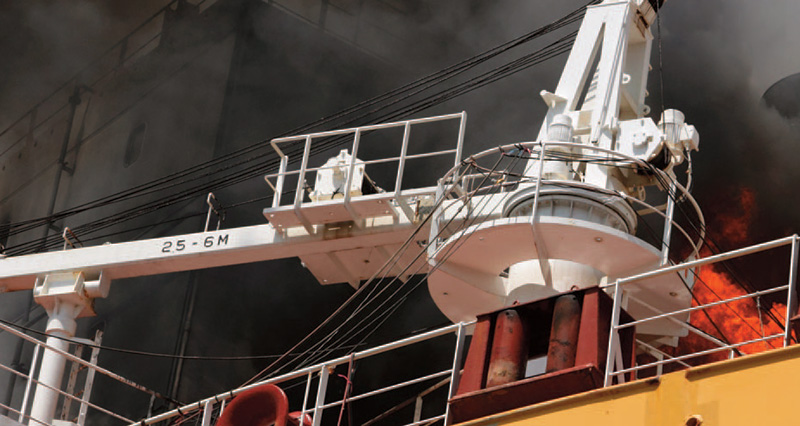
The bulk carrier had loaded Indonesian coal to be discharged at another Asian port. After loading, all the hatch covers and openings were closed and sealed. During the voyage, the cargo holds were monitored by taking gas readings and temperatures. All values were within the parameters stated in the IMSBC Code.
Discharging the coal
The vessel arrived at the anchorage for the discharge port. After a short wait, discharging began (by the vessel’s grab into barges). Initially, all went smoothly. However, after a few days of discharging, smoke started coming out of cargo hold 3. The coal that remained in this cargo hold had been left heaped in 6 metre piles by the bulkheads. A fire team was assembled and when they reached the cargo hold they could feel heat on the deck. Thick, dense black smoke then began coming out of the hold, although no flames were visible. The atmosphere in the hold was tested by the fire team and it was 66° C, methane gas levels were at 120% LEL, and the CO level was above 3,680 ppm. At this point smoke then started coming out of hold 4 which was almost empty. Again the cargo in this hold was in large piles by the bulkhead. The temperature was 69° C, methane levels were at 144% LEL, and CO levels were in excess of 10,000 ppm.
Expert guidance sought
The Master informed the DPA and charterer that the coal had self-ignited. Expert guidance was sought. There was now a risk of an explosion in holds 3 and 4. Flames could be seen on the surface of the coal. Two fire teams were assembled in full firefighting gear. They rigged the fire hoses and sprayed the coal with seawater. The Master wanted the remaining coal from holds 3 and 4 to be discharged and the following night the discharge from holds 3 and 4 continued to different barges. The next day, and in conjunction with the expert’s advice, the Master ordered holds 3 and 4 to be flooded. This action extinguished the fire.
What can we learn?
- There is nothing to indicate that the selfheating/combustion was in any way related to the actions of the Master and/or crew.
- Indonesian coal is prone to selfheating/spontaneous combustion. This is related to oxygen combining with carbon in the coal (oxidation) and this reaction produces heat. When the heat produced cannot dissipate – in this case due to the insulating effect of the surrounding coal – the temperature of the coal increases. Carbon monoxide (CO) is produced as a result of the self-heating/combustion reaction. As the temperature of the coal increases, so does the rate of the oxidation reaction. This is why guidance is given in the IMSBC Code to close the ventilation after loading as soon as it is apparent that flammable gas is not accumulating.
- When self-heating of coal has been restricted by reduced oxygen levels, such as during the voyage, self-heating will not become immediately apparent on exposure to higher levels of oxygen. Self-heating is a function of temperature, so the self-heating needs to occur for a sufficient time to raise the temperature of the coal before a runaway reaction will occur. This time period depends on the amount of oxygen that can permeate into the stow and support self-heating.
- The holds were not ventilated prior to the vessel’s arrival at the discharge port. The holds were only opened when discharging operations began. During discharge, oxygen will inevitably have entered the holds.
- The period between the start of discharging and the noticeable increase in carbon monoxide is consistent with exposure of the coal to atmospheric oxygen levels during discharging operations.
Downloads