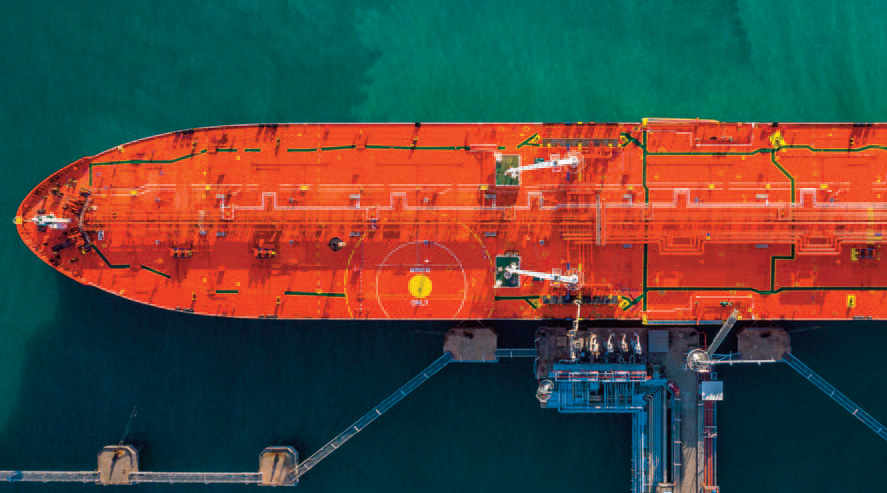
It was winter with temperatures around 2°C. The chemical tanker was in port loading a cargo of mixed xylenes (MX) (ref Marpol Annex II) in all its six cargo pair tanks. The previous cargo had been ethylene dichloride (EDC) (ref Marpol Annex II) which the vessel had carried on the two previous voyages. During the voyage to the loading port the vessel carried out tank cleaning. The loading was uneventful, and the vessel departed the following day and proceeded towards the discharge port.
Sampling
The vessel berthed and a cargo surveyor came on board to carry out sampling. The cargo in all tanks was found to be off-specification regarding chloride content.
Coating
During the investigation into the contamination, the coating on the cargo tanks was identified as the cause of the contamination. The tanks were coated with phenolic epoxy and it is believed that the coating was applied properly and in compliance with the requirements set out by the manufacturer of the paint. Such organic coatings absorb significant quantities of solvent-like cargo into the paint layer and subsequently desorb (release) these residues following discharge of the cargo. It is this property of absorption and desorption into and out of organic coatings that has led to a significant amount of cargo contamination claims, which is also believed to be the cause in this case. It should be noted however, that epoxy systems are resistant to strong acids and alkalis and do not generally absorb significant quantities of oil-like substances. These types of substances remain on the surface of the paint from where they can be removed using conventional cleaning techniques.
Cargo lines
As part of a change in cargo grade, a tank cleaning operation requires all cargo lines to be flushed to remove all traces or remnants of the previous cargo. Additionally, vent lines leading from the cargo tanks to the pressure/vacuum relief valves (P/V valves) also need to be flushed. This is done by opening the flange between the P/V valve and the vent piping for each tank and using a hose to flush this line. During the carriage of cargo, vapour from the tank can accumulate and condense within the vent line. These lines are designed to be self-draining to the cargo tank and any condensation will trickle back to the cargo tanks. It cannot be confirmed if this was done or not during the tank cleaning. The cargo was finally discharged to shore tanks and sold at a salvage price with a considerable loss.
What can we learn?
- The condition of the coatings in the cargo tanks had been allowed to deteriorate and this allowed cargo seepage and accumulation between the coating and the substrate. Combined with the absorption of the cargo of EDC into the phenolic epoxy coating, this seems to be the likely cause of contamination of the mixed xylene cargo with chlorides.
- All tank coatings should be inspected by a manufacturer’s paint technician and the damaged coatings repaired in accordance with the manufacturer’s instructions. It would also be prudent for the owner to have the coating assessed by the manufacturer to ensure that the chemical resistant properties of the coating are adequate for the intended trade of the vessel.
- A coating resistance list should be placed on board the vessel and made available to the crew. This list should always be referred to and for all loading operations. Where the coating resistance list states that the coating has ‘limited resistance’ to a cargo, it must be ensured – as far as practically – that two successive loadings of aggressive cargoes are avoided and, charterers for the following voyage should be advised of the possibility of contamination and an indemnity sought. The owner’s chartering department should also be made aware of potential risks when fixing the vessel. l Tank cleaning procedures and guidance provided by the owner in their procedures should be revised to include not only the need to refer to published industry guidelines such as Dr Verwey’s Tank Cleaning Guide or the Miracle Tank Cleaning Guide, but also to include guidance on the behaviour of different types of cargoes carried on chemical tankers and their effect on tank coatings.
- The crew needs to be trained in tank cleaning and tank coating maintenance.
Downloads