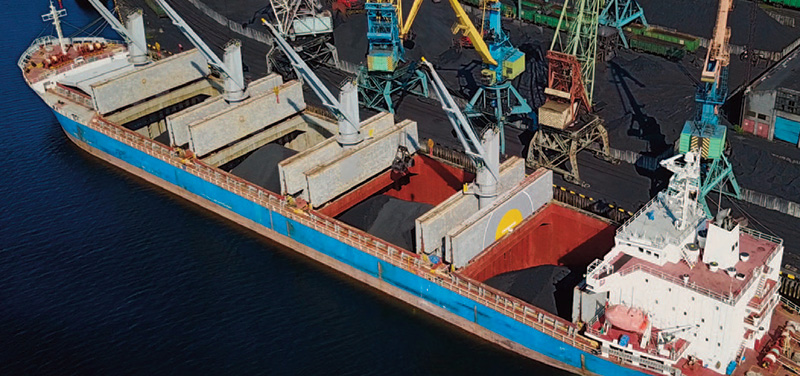
The capesize bulk carrier had loaded steam coal in all seven of its cargo holds. The Master had received the cargo declaration from the shipper where it mentioned that there was a risk of methane release, which is common for coal cargo. During the voyage the vessel had sailed through heavy weather conditions which reached Beaufort scale 8, but at the time of the incident it was a clear winter evening. The vessel was approaching port to anchor while waiting for a berth to be ready for discharging, and the bosun and an AB went to the forecastle to prepare the anchor.
Access to windlass control room
To start the anchor windlass, they had to enter the windlass control room on the forecastle. The forecastle was slightly elevated from the main deck and a ladder had to be used to reach it. The door to the windlass control room was below the forecastle, facing the stern towards the cargo hatch coamings of cargo hold 1. The hydraulic panel for the anchor windlass was inside the control room as were other equipment panels. The access hatch to cargo hold 1 was also in the room.
Explosion
The two crew members entered the room and approached the windlass panel. The bosun pushed the start button. At that moment there was a major explosion in the room. On the bridge they heard a large bang from the bow but could not really see what had happened because it was dark outside. The Chief Officer and another AB rushed to the bow to see what had happened. The Chief Officer approached the forecastle and touched the bulkhead to the windlass room. He could not feel any heat. He then shouted for the bosun but got no answer. He decided to open the door. He looked inside and there was almost no smoke in the room, but there were two bodies lying on deck, not moving. He could see that it was the bosun and the AB and he called on the radio for medical assistance and asked that two stretchers should be prepared.
Medical assistance
The Master called the VTS and asked for medical assistance. It took 10 minutes for the Second Officer to arrive at the scene with first aid equipment, and soon afterwards crew members came with two stretchers. The bosun and the AB had severe burn injuries, and there was not much the Second Officer could do but to give first aid and ensure that both men were breathing. An hour later a coast guard cutter with paramedics arrived and the injured crew members were taken ashore. They were flown to a specialist hospital where they received help. Both survived but had to undergo painful surgery and it is unknown if they will ever be able to work at sea again.
What can we learn?
- It is probable that an accumulation of methane gas occurred within the windlass control room. The gas mixed with the air allowed the right concentration of gas to be ignited inside the hydraulic control panel by a switch or relay. The resulting ignition within the panel created an explosive flame and pressure wave that rapidly expanded into the control room. It seems likely that the methane gas entered the control room through the cargo hold access hatch.
- After the incident the windlass control room was classified as an enclosed space, which means that the crew must test the atmosphere before entry to ensure it is gas free and has enough oxygen.
- The crew had planned to carry out gas testing of the cargo during the voyage. However, because of the heavy weather no testing was done the first week. Tests were carried out during the last five days before arrival; no excessive amounts of methane gas were detected. An attending surveyor stated that the onboard gas testing equipment was not suitable for cargo testing but was designed for personal use when entering a cargo hold.
- There should be testing equipment on board that meets the requirements of the IMSBC Code. It is also critical that the crew is properly trained on how to use the equipment. The vessel should have at least two gas meters on board (in case one should fail) with certificates of calibration that will cover the period of the voyage. At a minimum the meters should measure methane (usually in % of Lower Explosive Limit or LEL), carbon monoxide and oxygen. The LEL is the lower limit, below which a mixture of methane and air will not explode. For normal air (21% oxygen) the LEL is 5% methane. Gas meters usually measure the percentage of LEL with 100% representing 5% methane in air. Coal emits methane to varying degrees.
Downloads