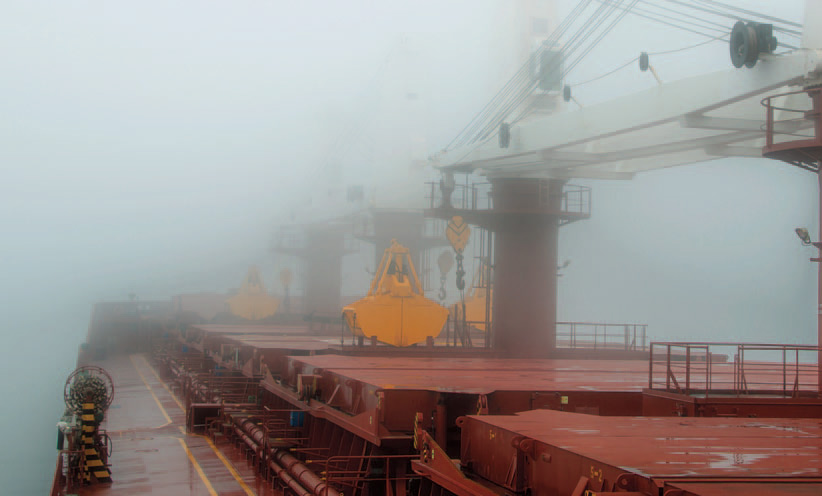
Vessel A was a 2,692 TEU container vessel underway. Shortly after commencing the sea passage, visibility worsened. The vessel was sailing through dense for with SW winds at Beaufort scale 6. On the bridge were the Master, OOW and a lookout. The Master had the conn. At 20:00 the Second Officer took over the watch from the Third Officer. The visibility was only 0.1 NM and the fog was persistent into the evening.
The Master stayed on the bridge the entire time.
Speed of 17 knots
Vessel A was maintaining a speed of 17 knots on a course of 240 degrees, the vessel was sounding fog signals. Both the ARPA X-band and S-band radar were used and the ranges were changed between 3 NM and 6 NM.
C -12 minutes: Vessel B was on the port bow about 3 NM from vessel A, making a speed of 6 knots on a 010 degree course according to the ARPA. Vessel B was about 11 o’clock from vessel A and crossing from port to starboard. The CPA was 0.0 NM and so a risk of collision existed.
C -10 minutes: The Master saw the name of vessel B on the AIS and called it on VHF channel 16, but had no response. He also used the searchlight to ash at the direction of vessel B as a warning signal. It is unlikely that vessel B would have seen this.
C -5 minutes: The Master ordered hand steering and an alteration to port to 210 degrees, in order to let vessel B pass ahead of vessel A. Shortly afterwards vessel B started to alter to starboard, resulting in a distance of 0.5 NM between them. The Master on vessel A ordered hard to port.
Collision: The vessels collided, and vessel B struck the starboard side of vessel A. The Master on vessel A now saw that vessel B was a fishing vessel. Continued at same speed and course However, the Master of vessel A continued the voyage at the same speed and course. After a while
the VTS called vessel A and told them to stop and await the coast guard. At the time of the collision the fishing vessel was fishing by casting fishing pots overboard.
What can we learn?
- The Master and OOWs must always consider the safe speed of the vessel. The crew may be under the impression that they have to maintain a high speed to meet a schedule and this can create conflicts of interest between meeting a schedule and sailing at a
safe speed. This is something that the Master and the owners must deal with in their safety management procedures to ensure that the vessel is navigated safely. - In addition, the greater risk of sailing at a high speed must always be evaluated by the Master and instructions conveyed to the bridge officers. Rule 6 advises that a vessel needs to be able to avoid a collision as per the prevailing situation. Proceeding at higher speeds will also attract a higher degree of blame when the courts apportion liability between the vessels involved in collision.
- The bridge team on vessel A was aware of vessel B for about 12 minutes before the collision. Despite the clear indication that the vessels were on collision courses, the Master of vessel A altered to port, towards vessel B and in contravention of rule 19. Under no circumstances should a vessel alter to port towards a vessel on its port bow in restricted visibility as vessel A did in this collision. The Master on vessel A stated that this manoeuvre was because he believed that vessel B was the give-way vessel and that vessel B would pass forward of vessel A. Under Rule 19, both vessels have an equal obligation to avoid a collision.
- It is not acceptable to continue a voyage after a collision and this was a very bad decision by the Master. He should have ensured that all crew on vessel B were safe before continuing the voyage, which he did not do.
- The Master had been on the bridge for five hours when the collision occurred. It is unknown how long he had been awake prior to this. However, according to the flag state investigation it is unlikely that the Master suffered from fatigue.
- In this case vessel B was plotted but the bridge team on vessel A did not act on the information and assumed that vessel B would alter course. It is important to ensure that bridge officers are well trained so that they can take critical decisions quickly and correctly. They
must understand the consequences of their actions, appreciate when no action needs to be taken, and know how to prevent a close-quarters situation. - Some safety management systems stipulate minimum CPA limits and manning levels in the navigation policy, depending on visibility and during critical operations such as approaching or leaving a port. However, generic requirements in the navigation policy may not
illustrate to officers what are acceptable limits and what are unacceptable limits. Many of these issues are covered in the Club’s Bridge Instructions booklet.
COLREGs
Rule 5 – Look out:
Every vessel shall at all times maintain a proper look-out by sight and hearing, as well as by all available means appropriate in the prevailing circumstances and conditions, so as to make a full appraisal of the situation and of the risk of collision. The bridge was manned sufficiently and the bridge team on vessel A plotted vessel B at an early stage. However, the bridge team did not act on their observations.
Rule 6 – Safe speed:
Every vessel shall at all times proceed at a safe speed so that she can take proper and effective action to avoid collision and be stopped within a distance appropriate to the prevailing circumstances and conditions. In determining a safe speed, the following factors shall be among those taken into account. [(a) By all vessels:]
(i) the state of visibility:
(ii) the traffic density including concentrations of fishing vessels or any other vessels: A speed of 17 knots in restricted visibility in an area with
fishing boats can be considered unsafe.
Rule 7 – Risk of collision:
(a) Every vessel shall use all available means appropriate to the prevailing circumstances and conditions to determine if risk of collision exists. If there is any doubt [then] such risk shall be deemed to exist.
The CPA was 0 when vessel A plotted vessel B at C -12 minutes. It should have been apparent to those on the bridge of vessel A that there was a risk of collision.
Rule 19 – Conduct of vessels in restricted visibility:
(a) This Rule applies to vessels not in sight of one another when navigating in or near an area of restricted visibility.
(b. Every vessel shall proceed at a safe speed adapted to the prevailing circumstances and conditions of restricted visibility. A power-driven vessel shall have her engines ready for immediate manoeuvre.
(d) A vessel which detects by radar alone the presence of another vessel shall determine if a close-quarters situation is developing and/or risk of collision exists. If so, she shall take avoiding action in ample time, provided that when such action consists of an alteration of course, so far as possible the following shall be avoided:
(i) an alteration of course to port for a vessel forward of the beam, other than for a vessel being overtaken:
(ii) an alteration of course towards a vessel abeam or abaft the beam.
Vessel A altered to port, which is in contravention of rule 19 as vessel B was on the port bow of vessel A. At no time did the Master on vessel A reduce speed.
Downloads