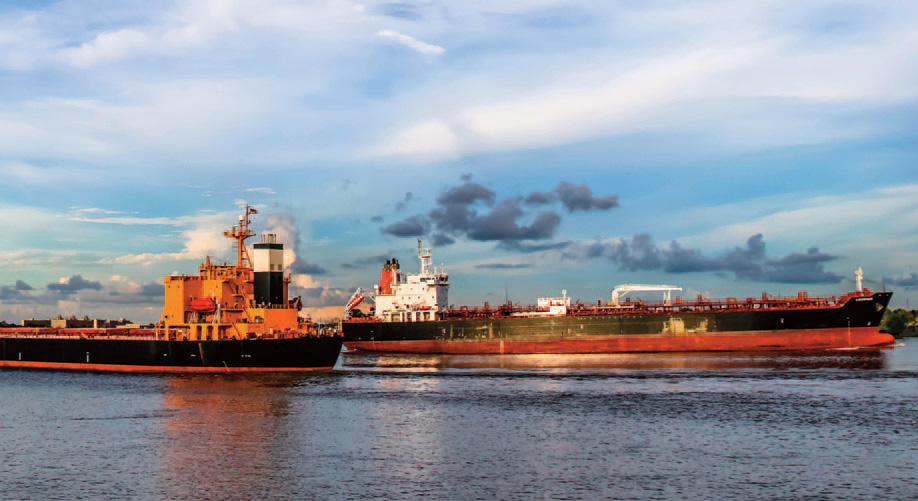
It was the middle of the night and vessel A, a 6,500 TEU container vessel, was sailing out from a port in a busy river with a pilot conning the vessel. The weather was fine with clear skies and winds at around Beaufort scale 6. All navigation equipment on vessel A was in good working order except for the AIS transceiver, which was not working.
Vessel A was on an easterly course in the outbound deep-water channel of the river fairway. Vessel B was proceeding on a reciprocal course in the inbound fairway of the river. The vessels were in sight of each other. The Master, Chief Officer, lookout, helmsman and the pilot were on the bridge of vessel A.
Underestimated weather conditions
Vessel B, a handymax bulk carrier, then reduced speed in order to time arrival for its berth. However, the bridge team on vessel B underestimated the impact of the wind and current, and the vessel was set towards the outbound fairway and its heading altered to port and towards vessel A. This caused vessel B to enter the outbound fairway.
No room for manoeuvre
Vessel A was sailing in the fairway of the extended deep-water channel but towards the centreline between the inbound and outbound fairway. The bridge team saw that vessel B had slowed down and that its heading was changing towards them. There was some room for vessel A to turn to starboard and still remain in the fairway, but it was limited. The vessels were approaching each other, and vessel A was not able to turn to
starboard and clear vessel B and still remain in the fairway.
An attempt to communicate
The pilot on vessel A flashed the signal lamp and called vessel B on the VHF but vessel B did not respond. The pilot ordered full astern and tried to alter course to starboard with the bow thruster. This did not prevent the collision. The Master on vessel A saved the VDR data after the accident.
There were no injuries or pollution.
What can we learn?
- If we look at this case from vessel A’s point of view, there are several problems in this collision which could have been resolved if the pilot had clarified the intentions of vessel B.
- The major fault in this collision lies with vessel B as it drifted into the opposite fairway when it slowed down. What happened on vessel B’s bridge and why it did not respond to vessel A or take any action when it started to drift is unknown.
- It is important to continually evaluate all traffic, especially if the vessel is in a congested area such as approaching or departing a port. In the port state investigation, vessel A was found to be positioned close to its starboard side of the fairway, and this was identified as a fault. However, vessel B was found to be preponderantly to blame. The bridge team was not maintaining a proper look-out, they did not respond on the VHF and vessel B failed to stay clear of vessel A as it drifted into the opposite side of the fairway. The investigation also raised the issue of vessel A not having a working AIS.
- It is important that the bridge team has a departure briefing, where different scenarios are discussed, and the potential risks identified. When the pilot boards, the Master should discuss the plan for the pilotage. It is also important that the Master asks about local regulations, concerned traffic, expected currents and winds, and knows what the passing requirements are and how the pilot plans to approach the departure. If the local language is spoken the pilot must share the conversation, in English, with the bridge team.
- If the Master for some reason is not confident in the pilot’s orders, he needs to voice this concern immediately. If he believes the vessel’s
safety is at risk, he must relieve the pilot. It is not uncommon for The Swedish Club to find that following navigational claims the Master
has afterwards stated that he was concerned with the pilot and how they navigated the vessel. However, he did not relieve the pilot and
take over. - It is important that Masters are confident enough and are trained on how to challenge correctly. As in any line of work there is a vast
difference in competence between different pilots and officers around the world. The safety of the crew and vessel should always be the
Master’s priority.
COLREGs
Rule 5 – Look out:
Every vessel shall at all times maintain a proper look-out by sight and hearing, as well as by all available means appropriate in the prevailing circumstances and conditions, so as to make a full appraisal of the situation and of the risk of collision. In this case vessel B failed to keep a proper look-out.
Rule 7 – Risk of collision:
(a) Every vessel shall use all available means appropriate to the prevailing circumstances and conditions to determine if risk of collision exists. If there is any doubt [then] such risk shall be deemed to exist. When vessel B drifted towards the outbound side of the channel it should have been clear to both vessels that a risk of collision was developing. Vessel B did nothing, and vessel A tried to contact vessel B instead of taking evasive action. The COLREGS do not mention the use of VHF. The rules are clear and should not require any discussion between the vessels.
Rule 9 – Narrow channels:
(a) A vessel proceeding along the course of a narrow channel or fairway shall keep as near to the outer limit of the channel or fairway which lies on her starboard side as is safe and practicable. Neither of the vessels navigated near the outer limits of the fairway.
Downloads