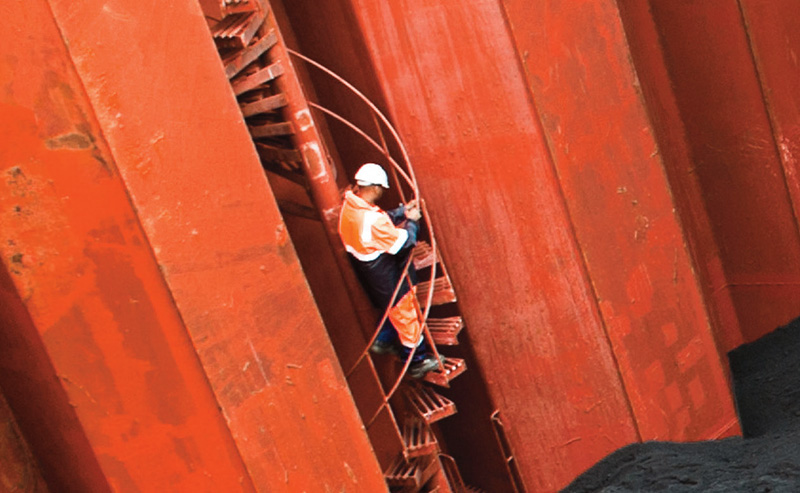
Two stevedores were in the cargo hold finishing their job. It was in the morning and they had started their shift the previous evening. They had worked for more than 12 hours. When they were leaving they had to first climb up a vertical ladder, then ascend a spiral staircase and for the last 2.5 metres climb up another vertical ladder to get out of the cargo hold.
The stevedores had brought a thermos and tea cup each. The cup did not fit in the first stevedore’s boiler suit pocket so he held it in his hand instead. This wasn’t a problem when he ascended the spiral staircase. However, when he reached the last platform there was still the vertical ladder to climb up. Climbing up the last ladder he only used one hand as he had the tea cup in the other. He was not wearing a safety harness. When he was almost at the top he slipped and fell down. Unfortunately, he did not hit the platform below but fell more than 20 metres and landed at the bottom of the cargo hold.
The other stevedore shouted for help which the bosun heard. He could see the stevedore lying at the bottom of the cargo hold and instantly called the Chief Officer on the radio and told him about the accident. The Chief Officer assembled a rescue team with a stretcher and gave the stevedore first aid. An ambulance arrived shortly afterwards and he was lifted out of the cargo hold by a crane. Unfortunately, he was declared dead at the hospital. It was later found that a steel bar was missing from one of the lower railings at the beginning of the spiral ladder. The railing was most likely damaged during the loading by one of the crane grabs, or an excavator as it was covered by the cargo when it arrived at the discharge port.
What can we learn?
What can we learn?
- The definition of ‘working at height’ should be addressed in the risk assessment, in addition to details of the safety measures that need to be taken.
- In the risk assessment it should state whether the specific job requires a work permit.
- It is up to every company to define if they consider it an acceptable risk to enter the cargo hold on a vertical ladder without a safety harness attached.
- In this specific case the person climbing the ladder only used one hand and had no safety harness. The problem here is how the stevedore perceived the risk at the time.
- Most of us would agree that it is safer to use both hands when climbing a ladder. However, when climbing ladders is a daily occurrence it is easy to forget that the consequences of slipping can be fatal. Advise from COSWP states that climbing a ladder three points (foot or hands) should always be in contact with the ladder. When the consequences of falling from that ladder are so severe, a harness should really be used.
- It would be beneficial to have a tool box meeting with the stevedores’ supervisors to explain what is required of the stevedores when working on board.
- It is understood that many ports require that stevedores wear a safety harness when climbing the cargo ladder. It is important that the Chief Officer emphasises the importance of complying with this requirement.
- After both loading and discharging, the Chief Officer should inspect the ladders to ensure they have not been damaged during the cargo operation.
- This accident highlights the minimal effort it takes to do a job safely, and the consequences of not making that effort.
Downloads