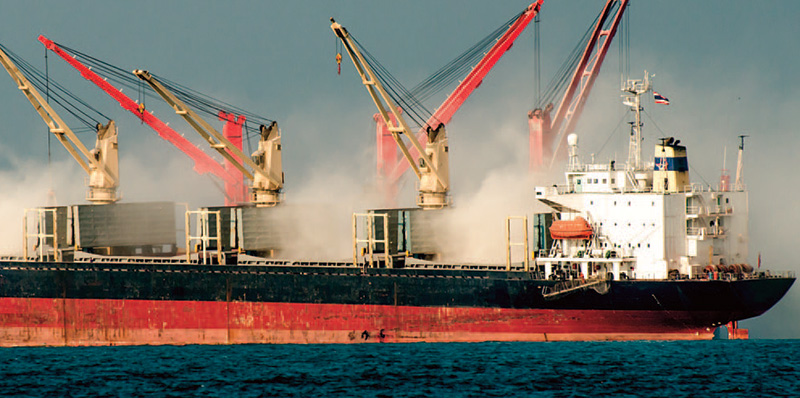
A bulk carrier had loaded soya beans by conveyor belt in a South American port bound for a port in the Gulf of Arabia. The vessel arrived at the discharge port, but berthing was significantly delayed. The vessel had to remain at anchor for four months as the charterers had not been paid for the cargo. One day the crew discovered smoke and heat coming from inside the holds. Two days later the vessel berthed.
Total loss
Eventually, it was ascertained that a considerable amount of the cargo was damaged. The invoiced value was over EUR 4 million. However, due to the damaged cargo, the local authorities declared the entire cargo to be a total loss and ordered the cargo to be destroyed. The cargo receiver arrested the vessel and demanded over EUR 5 million in compensation.
Inherent vice
It appears that self-heating damage occurred solely due the inherent nature of the cargo. It was established that there was no water ingress of any kind. It was also established that the damage was not caused by heat from any fuel oil tanks adjacent to the cargo holds. All possible causes involving the negligence or unseaworthiness of the vessel were excluded in the investigation of a fire expert. However, the Club received legal advice from local lawyers that it was highly unlikely that the owners could successfully rely on the ‘inherent vice’ defence before the local courts. The main reasons given were that: 1) local court action could drag on for years and 2) the local courts tended to protect local companies when they were in dispute with foreign companies.
Recovery
Based on the local lawyers’ legal advice, the Club had to settle the case amicably with the cargo owners. However, the Club in turn made a full recovery by bringing a claim against the charterers under the charterparty between the owners and the charterers (more specifically, by relying on the Interclub Agreement). The recovery action turned on the interpretation of clause 8(d) of the Interclub Agreement.
Clause 8(d) provides that:
“(8) Cargo claims shall be apportioned as follows: …
(d) All other cargo claims whatsoever (including claims for delay to cargo):
50% Charterers
50% Owners
unless there is clear and irrefutable evidence that the claim arose out of the act or neglect of the one or the other (including their servants and sub-contractors) in which case that party shall then bear 100% of the claims.”
The arbitration tribunal agreed with the owners’ argument. The English Court upheld the decision holding that the owners did not need to prove fault or negligence in connection with the charterers act. The charterers’ appeal was dismissed.
The charterer ended up having to pay the owners the unpaid hire and 100% of the cargo claim the owners had paid, together with legal costs and expenses.
What can we learn?
- South American ports commonly use conveyor belts to load soya bean cargoes, which create airborne dust and particles around the holds. Under such conditions, the on-site crew may be unable to distinguish between dry cargo and cargo with a considerably high moisture content by visual and smell inspections. Nonetheless, the crew is advised to take photographs to demonstrate the poor visibility during loading operations.
- The Chief Engineer should ensure that all engineers and engine ratings are aware of the procedures for heating fuel oil to prevent any cargo damage.
- The crew should check the temperature of the cargo at regular intervals, preferably at least 50cm below the exposed surface of the cargo.
- The owner/manager should always consider obtaining assistance from an experienced surveyor, or cargo expert, or more conveniently call their club for assistance whenever there are doubts as to the condition of the cargo that is being loaded.
- During the voyage, the cargo should only be ventilated according to the Three-Degree Rule, which recommends that ventilation should only be carried out when the outside temperature is 3°C lower than the cargo temperature at loading.
- The ventilation logbook should be completed properly.
- At the discharge port, owners/managers are reminded to contact the Club immediately if there is any indication by the crew, the receivers, or the local authorities that cargo has suffered damage by self-heating.
- Cargo experts should be called upon immediately to observe the pattern of damage in the cargo hold(s) and to take samples for analysis for evidential purposes (i.e. potential defence against a claim by the cargo receivers).
- The carrier should not be held liable where the owner provides the same management and standard of care for the cargo holds containing the same type of cargo (i.e. soya beans), which was loaded in sound condition, but results in different outcomes in terms of damage.
- One of the most effective defences against cargo claims is the maintenance of clear and accurate records and documentation of each stage of the voyage, from loading through to discharge. The crew can assist by maintaining detailed and accurate logs and taking photographs throughout the voyage.
- The charterers alleged that the cause of the damage was the owners’ failure to properly monitor the cargo temperatures. The Tribunal however found that the monitoring was not at fault and that the cause of the damage was a combination of the inherent nature of the cargo (and its oil and moisture content) together with the prolonged period at anchor at the discharge port.
Downloads