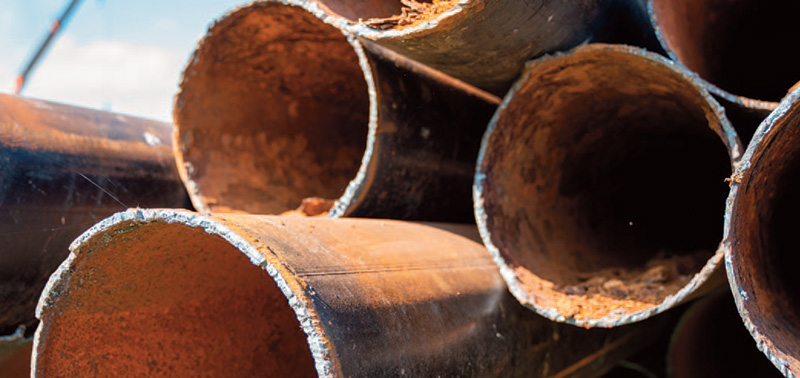
The handymax bulk carrier had loaded steel pipes and steel coils in Asia to be discharged in North America. Before loading, all holds had been swept with brooms, washed with seawater, and then rinsed twice with fresh water. A hatch cover test (hose & chalk) was carried out at the loading port and the holds were accepted for loading. The last three cargoes were potash, sugar and palm kernel in bulk.
Damage on loading
During loading there had been some intermittent rain but according to the crew the cargo hatch covers had then been closed and the loading had been stopped. The preloading inspection highlighted that some of the pipes were loaded in a partially dented condition and were rust stained. Furthermore, a few steel coils were noted to have physical damage, and the galvanizing of the outer covers had been affected by oxidation marks. There were also broad rust marks on the port side tank top. Lumber dunnage, steel straps and wires were used to secure the cargo in the holds. Bundled steel pipes were wrapped with polypropylene sheets and tightly bound with steel bands. However, the ends were exposed. When the loading was completed, marine tape was used across the cross joint seams to prevent water from entering.
Heavy weather
During the vessel’s voyage over the Pacific it encountered heavy weather at Beaufort scale 10 with green seas covering the deck and cargo hatches. After the heavy weather the crew found that the cargo had shifted. To secure the cargo the crew used additional timber dunnage, but it was to no avail.
Poor ventilation
In the discharge port many pipes were found to have white rust or zinc hydroxide (galvanizing affected by oxidation marks) and red rust on the exposed ends. Zinc hydroxide is the white or grey rust deposit formed by accelerated corrosion of the zinc coating when closely-packed, recently galvanized articles, are stored or shipped under damp and poorly ventilated conditions. The vessel had both natural and mechanical ventilation, but this had not been used for a month because of the heavy weather.
Damage
A sliver nitrate test was carried out and it came out positive. Some of the pipes also showed physical damage (i.e. nicked/flattened ends) due to compression. Most of the rusted pipes were on the port side under the cross joints of the bi-folding hatch covers. Stevedores in one of the discharge ports had placed steel plates over the cargo as a protective barrier in order to use their forklifts to handle the cargo. Because of this some of the pipes were damaged due to the forklift driving directly on top of the pipes. The Master issued a Letter of Protest to the stevedores. The cargo hatch covers were inspected and found to be in acceptable condition. The consignee claimed extensive and widespread physical damage including compression dents, crushed and torn ends, bending, broken bundles, as well as rust, corrosion and stains on their cargo.
What can we learn?
- Before sailing it is essential that the crew makes sure that all cargo hatch covers, and other openings are secured properly and are in a weathertight condition.
- To ensure that the cargo hatch cover is secured properly it should be secured in port as per the manufacturer’s instructions.
- For complete information on how to maintain the cargo hatch covers, please refer to the manufacturer’s manual. It is also important to always use original spare parts.
- Cargo holds are often washed with seawater after unloading, leaving chloride-laden residues behind. The final washing should be done with fresh water. This is especially important if coal, iron ore or phosphates have been loaded previously. If this is not done, ship’s sweat containing salt crystals will contaminate the steel and accelerate the development of rust. This can also give a false impression that it is the cargo hatch covers that have been leaking.
- Coils are stowed with the coil eye in a horizontal position. This is done for ease of handling and to minimise surface damage. Coil stowage crucially depends on the correct location of the lower layer of coils, with dunnage used as necessary to avoid damage to the tank top (or supporting structure) and the outer bulkhead. Comprehensive guidance on dunnage placement is given in the IMO’s Assembly Resolution A.714 (17), 1991 Code of Safe Practice for Cargo Stowage and Securing (CSS Code), as amended. The stowage of steel coils is quite complex, and guidance should be sought when in doubt.
- The dunnage utilised must be suitably dry to avoid transferring moisture to the product and to the hold’s atmosphere. The dunnage must also be phytosanitary-certified and approved to ensure the wood is pest free. Without this certification, the vessel may be banned from offloading cargo in some territories. Hardwood dunnage is preferred to avoid crushing during the voyage and consequential cargo damage.
- Steel coils must be anchored by wooden wedges (dry wood), which are nailed in position to the supporting dunnage board; the wedges are positioned to stop coils moving during rough seas. A centre coil, known as the locking coil, is positioned and secured by steel straps to the coils immediately below.
- If defects/abnormalities are observed during the pre-loading and loading operations e.g. evidence of damaged straps, unwinding or telescoping, damage to packaging, then the bills of lading should be claused.
- Even if the charterer is responsible for loading the cargo, the Master is responsible for ensuring that the vessel is seaworthy before departure.
- To minimise the impact of heavy weather and the likelihood of excessive green seas on deck, corrective action, such as reducing speed or altering course, should be taken.
- Weather routeing is recommended as this not only provides vessels with the option of avoiding heavy weather, but also ensures that the vessel gets new, updated ETAs for the discharge port. This helps the crew on board the vessel, shoreside personnel, and cargo owners, to plan accordingly
Downloads