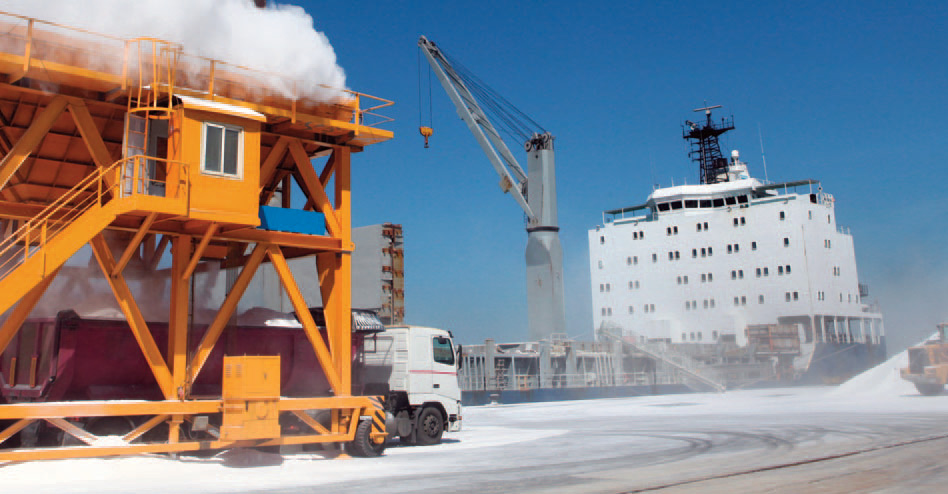
A large cargo of urea was found to be ‘caked’ when it was being discharged in Africa. However, the cargo was discharged normally by grab etc. There were some lumps that remained in the urea when it was discharged. Direct bagging was employed on the dockside. There was not a grid on the hoppers for the packing, so part of the urea was discharged in bulk to a dockside warehouse for manual packing.
A cargo expert attended but by the time he arrived the urea had all been discharged and the ship was under arrest for the quality of the urea, specifically the nitrogen content, and for caking.
Local laboratory sampling
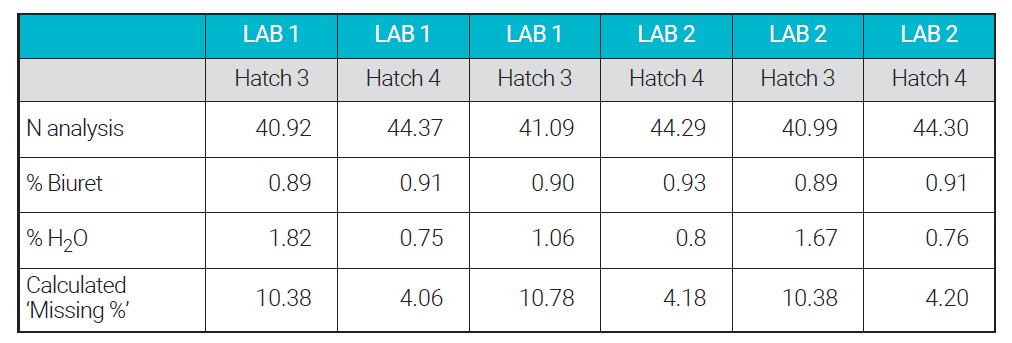
Tripartite samples had been obtained during an inspection by the interested parties and these had been submitted to two local laboratories. They had been analysed for nitrogen, biuret (an unavoidable chemical produced during the manufacture of the urea) and water (there will always be some remaining from manufacture – more can be accumulated during subsequent storage/transport). Urea should contain at least 46% N. The calculated ‘Missing %’ was calculated from the nitrogen analyses achieved. The stock was examined and there was no sign of anything other than urea present; all the cargo was pure white and the appearance of the prills (small pellets) looked normal. Any contaminant must therefore have been visually identical to the urea – pure white prills – but containing zero nitrogen to have reduced the nitrogen content to the observed levels.
Fines
Some of the samples were analysed for the percentage of fines (below 1mm). Results ranged from 7.0% to 17.1% with an average of 12.2% – the specification was a maximum of 10%
Further laboratory testing
Further tripartite sampling had been carried out by the parties during discharge by dropping a grabful of urea onto the deck. Three surveyors then took samples from the load. The operation was repeated five times for three of the five holds. Samples were sent to an internationally recognised laboratory in England for analysis.
- All analysis results for nitrogen were in specification, exceeding the minimum nitrogen content. The local analyses above, were therefore highly suspect.
- The global average for moisture content was 0.38% – much lower than the local analysis result and well within specification.
- The percentage of fines was highly variable even for samples taken from the same grabful. However, the global average for fines was 8.9% and the specification was satisfied.
The arrest of the ship was lifted, and no further claim was made.
What can we learn?
- This case highlights the importance of good quality sampling and analysis in relation to quality disputes.
- Samples should ideally be taken during loading. The sampling procedure should follow local or international standards and should be documented with a Sampling Report.
- If a portion of the sample from the sampler after loading is provided, then preserve it for possible future analysis. Store it in a cool dry place away from heat and out of direct sunlight.
- If the urea becomes lumpy as discharge proceeds, with uniform lumps becoming harder at greater depth, then this is caused by ‘caking’. Caking is caused by a combination of many factors but is NOT caused by any fault of the vessel. Caking of urea can easily be distinguished from lumps caused by water-ingress by an expert when provided with a suitable photographic record. Caking is NOT associated with water ingress. It is strongly recommended that there are suitable photographs taken and that expert advice is sought as soon as possible
Downloads