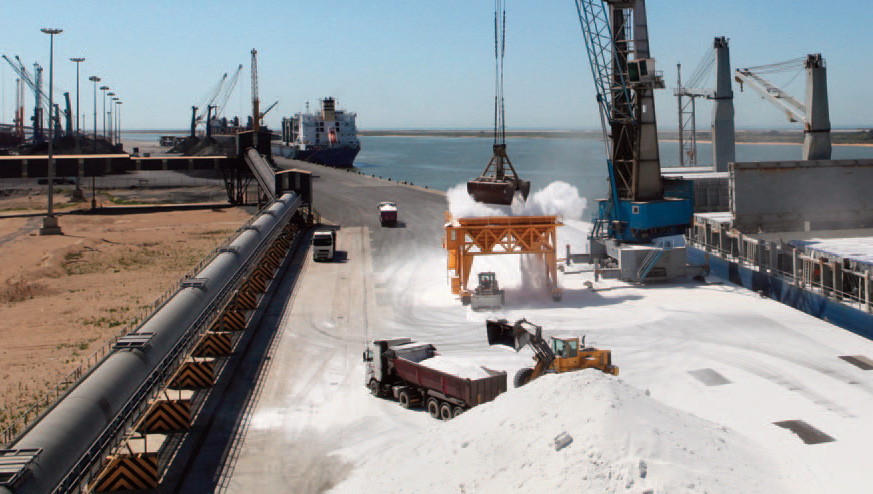
During discharge of a urea cargo, ‘stripes’ of dirty urea could be seen. Urea should be pure white. The contamination was believed to have been caused by using dirty wagons to transfer the urea to the ship.
Fertilizer grade vs industrial use
The cargo receiver required the urea for industrial use – the manufacture of urea-formaldehyde resin, which is used, for example, in the manufacture of white articles such as electrical light switches. The cargo receiver blamed the vessel for permitting the loading of contaminated urea (even though the vessel was not responsible for the cleanliness of the delivery wagons). There was a long discussion between an expert and the cargo receivers, where it was highlighted that the vessel had followed procedures that were applicable for fertiliser grade urea rather than the more detailed cleanliness requirements that would be appropriate for their industrial grade.
Considerations with contamination
Other types of contamination of urea cargo have included contamination with foreign materials (coal, grain etc. from previous cargoes). If such contamination is observed during loading, there are several options. An obvious point to consider is to ask the ultimate cargo receivers “does this matter?” – appropriate measures can then be readily identified. A Letter of Indemnity could be appropriate.
At discharge port
If the contamination is only observed at the discharge port, it may still be acceptable to the cargo receivers. Contamination that is localised is probably due to inadequate cleaning from previous cargo – however, in virtually every case the holds would have been inspected prior to loading. Other sources of contamination might be the loading equipment or contamination of the urea during previous transport/storage or on the quayside.
Prior to loading
Contamination that is spread throughout the cargo is probably introduced from the urea prior to loading – it is very difficult to apportion blame in such cases and each must be treated on its merit.
Grains
Contamination with grain can be difficult to resolve. In some instances, entire cargoes have been sieved in order to remove maize kernels. Removal of wheat grains is not possible by sieving because they are a similar size to the urea and the cargo may have to be sold to a less-discerning customer.
What can we learn?
- Before loading a specification will have been agreed between the various parties. If no specification has been provided to the vessel, then it should be requested. If a specification is not provided, then this should be recorded.
- Urea is usually pure white. This means that any coloured contamination will be obvious. It is therefore particularly important to remove any traces of previous cargo especially grain or sulphur. Only a few grains of corn or a few granules of sulphur have given rise to customer complaints. Normal inspection of the holds should pick up such problems. Small quantities of contamination are relatively unimportant for fertiliser use but industrial customers need to have urea without contamination.
- Samples should ideally be taken during loading. The sampling procedure should follow local or international standards and should be documented with a Sampling Report.
- Check loading equipment for cleanliness prior to use. Do not load contaminated spillage and dispose of contaminated urea safely in line with local regulations.
Downloads