The IMO, in CCC.1/Circ.2/Rev.1 dated 20 September 2017, introduced a new category of bauxite cargo, known as ‘bauxite fines’ in Group A of the IMSBC Code. Bauxite fines are a particular type of fine-particulate bauxite that are liable to liquefy or experience dynamic separation. The recommendations in CCC.1/Circ.2/Rev 1 were adopted as IMO Resolution MSC.462(101) and came into force on 1 January 2021.
Since that resolution there appears to have still been a number of incidents of loading and shipment of bauxite cargoes, which may have liquefied or exhibited dynamic separation during the voyage. The question arises as to whether that cargo was incorrectly declared as Group C (solid bulk cargoes not prone to instability) rather than being classified as Group A (solid bulk cargoes prone to liquefaction) in accordance with the recent IMSBC code update for bauxite.
Differentiating between Group A and Group C bauxite
It is important to remember that, aside from bauxite fines (Group A), other kinds of bauxite cargo are still classified as bauxite (Group C). The objective of the IMSBC Code updates is to identify bauxite cargoes that are prone to moisture-induced instabilities that can be of a sufficient magnitude as to affect the vessel stability. Consistent with the IMSBC framework, this is done by considering the range of particle sizes in the cargo as loaded and using that to screen out the high-risk cargo (Group A, prone to moisture-induced instability) and the low risk cargo (Group C, not prone to moisture-induced instability). This is illustrated by the diagram below, which depicts an ideal cargo of coarse and fine particles, and examines the changing nature of the cargo as the amount of fines increases.
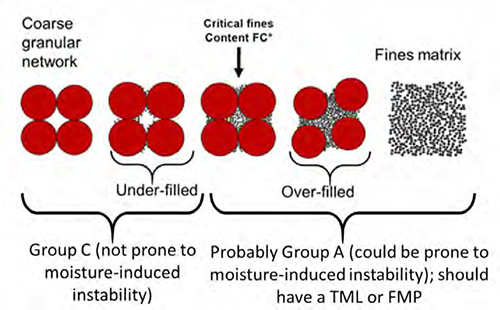
Figure (i) – Particle distribution of an ideal cargo illustrating the gradual change in behaviour
A cargo dominated by coarse particles would be free draining and so would not tend to generate high pore water pressures associated with moisture-induced instability. This is called an ‘underfilled’ soil fabric as the pores between the coarse particles are not filled by fine particles and remain available to ensure that the material is free draining. This would be a Group C cargo. At the other extreme, a cargo consisting only of fine particles would not be free draining and could potentially generate high pore water pressures under adverse circumstances. In between, is a critical point at which there are just sufficient fines to fill the voids between the coarse particles. Theoretically, this separates the different classes of behaviour.
Testing of bauxite cargoes
However, reality is more complicated and the coarse particles of some real cargoes are themselves fragile, and can break down into finer particles during shipment or on soaking. For this reason, it is very important that testing of bauxite for particle size distribution be carried out by wet sieving, with samples wetted up from the as-sampled water content without pre-drying. This ensures that fragile coarse particles, if present,
disintegrate into their finer constituents so that the appropriate particle size distribution is correctly measured for cargo classification. This is recognised in the IMSBC Code changes for bauxite and bauxite fines and may well apply to other lateritic solid bulk cargoes produced by similar geological processes. Accordingly, the Global Bauxite Working Group, which researched international sea-borne bauxite cargoes on behalf of the IMO (International Maritime Organization), determined that bauxite cargoes with the following particle size range should be classed as Group A, unless demonstrated to be otherwise by more sophisticated testing. Other bauxite cargoes should be classified as Group C.
Bauxite fines (Group A):
a) More than 30% of the cargo (by dry weight) are particles with a diameter that is less than 1 mm, and
b) More than 40% of the cargo (by dry weight) are particles with a diameter that is less
than 2.5 mm.
It is admittedly difficult for the Master to tell, from a visual inspection, whether the bauxite that is being presented for loading is to be classified as bauxite fines or bauxite. In essence, the Master is obliged to rely on the Shipper’s Cargo Information Sheet (CIS). It is a long-standing question as to what relatively simple independent checks could made by the Master to give confidence of the shipper’s information. There is no simple answer to this.
The ‘can’ test
The can test is recommended in Section 8 of the IMSBC Code ‘for determining the possibility of flow’, and is a simple hand test that is often carried out by Masters to gain an impression of the cargo’s response to dynamic impact. However, this test method has many limitations that mean that the results provided are only indicative and are not conclusive. One example of the limitations of the can test is that a typical can is too small to contain a representative sample of the cargo, if the cargo contains particles with diameters that are more than about two centimetres. This means that only the fine fraction of the cargo would be tested in the can test and that may not reflect the behaviour of the overall cargo with its full range of particle sizes.
This is not to say that the can test should not be conducted by the Master. As permitted by the IMSBC Code, it should – but the limitations of the test should be appreciated – i.e. a passed test does not mean that the cargo is guaranteed to be safe and a failed test does not mean that the cargo is definitely unsafe. If can tests are conducted, we recommend that they are videoed or photographed with a reliable record of the location and time of the test. The locations at which samples were taken for the tests should also be recorded and photographed. Photographs of sample locations should not only show the immediate locality at which the sample is taken. There should be lower magnification shots showing the position of sampling relative to the whole heap or stockpile. Videos and photos of the cargo as offloaded from grabs or conveyor belts or trucks are also useful for illustrating the mechanical consistency and behaviour of the cargo and are encouraged. They can then be used for further expert analysis, should the need arise.
The Cargo Information Sheet (CIS)
With respect to the CIS, the Master should not simply rely on the shipper’s declaration of Group A or Group C but also pay attention to the declared particle size. If the shipper has declared particle sizes within the range given above and has still classed the cargo as Group C, then the Owners should challenge the shippers and the Charterers about this discrepancy in the CIS. In addition, if the shipper has declared the cargo as Group C but has quoted a Transportable Moisture Limit (TML) or Flow Moisture Point (FMP), then this should be queried, as these parameters apply to Group A cargo, not Group C, and may point to incorrect procedures or understanding of the IMSBC classification and testing system (see Figure (i) above). In any case, the Master should request the information upon which the Cargo Declaration is based. This should include cargo particle size distribution curves, date of the applicable test results, frequency of testing and test laboratory. It is also helpful to request the cargo water content test results and the cargo sampling procedure that has been followed.
If the shipper has mis-declared the particle size of the cargo and/or the correct classification of the bauxite in the CIS, then this would be a breach of the charterparty by the Charterers. As there is no simple way to tell by sight that the cargo is Group A or Group C, the general advice is that if the cargo looks very fine and is still classified as Group C, or the certificate is inconsistent as discussed above, then raise an alarm.
Other indications
It is difficult to say with certainty which geographical areas around the world tend to ship bauxite fines. It is easier to identify the conditions where bauxite fines are not usually found:
(i) Where the bauxite exists as hard strata that has to be blasted (provided it is not then crushed excessively).
(ii) Where the bauxite comes out as pebble-sized particles, provided these particles themselves are not fragile and do not disintegrate on wetting.
(iii) Where the bauxite has been washed to separate the coarse and the fines, and the coarse fraction is being shipped.
If faced with having to determine whether the bauxite is safe to carry, these are questions that an Owner could ask the Charterer to clarify (via the shippers) and which could be more clearly worded in the charterparty clauses.
Some legal considerations
The Master is entitled to a reasonable period to determine whether they should comply with the Charterers’ instructions. Depending on the circumstances, the Master may have acted reasonably in delaying the loading and/or departure of the vessel (pending testing) even if the cargo is subsequently determined to be safe. However, it would be advisable for the Master (and the Owners) to remember that whether such delay is reasonable will depend on the specific facts and circumstances in each case.
Members should consider drafting bespoke clauses in the charterparty concentrating on the following issues:
- More specific circumstances in which the vessel would be considered off-hire (or not) in relation to the time spent by the Master to determine whether or not the cargo is a Group A or Group C cargo.
- There are clauses in respect of stowage (for eg.Clause 8 of the NYPE 1946 form) or rider clauses which provide an obligation for the Charterers to provide evidence to the Master that the cargo has been packed, labelled, loaded, stowed, carried and discharged in accordance with the IMO IMDG Code and the IMSBC Code as well as the CIS. However it is useful to make sure that such clauses are clearly worded.
- Although there are common law cases that provide Owners with an implied right to an indemnity from the Charterers that the cargo being loaded is safe, this can always be strengthened with express indemnity clauses. The above list is not exhaustive. Members should seek assistance either from their lawyers or from the Club, when considering which clauses should be drafted. Often, this will depend on the commercial circumstances of the fixture. It is important when drafting, that the intentions behind the clauses are reasonable and clearly set out in a balanced manner. The objective should be to achieve clarity, not for one side to try to gain an advantage over the other.
Loss Prevention Essentials
- Carry out a can test of the cargo to be shipped.
- Video or photograph the can test carried out. Note location and time of the test.
- Make sure that the declared particle size in the CIS corresponds to the shipper’s classification of the cargo.
- If any inconsistency is noted in the CIS, this must be raised with the shipper immediately.
By Nicholas Woo (Partner, Birketts LLP) and Dr Chris Menkiti (Senior Partner, GCG)
Downloads