Introduction
The loading, carriage and discharge of bulk grain and oilseed cargoes presents numerous challenges. This advice highlights the main areas to consider when carrying bulk grain and oilseed cargoes. One of the most effective defences against cargo claims is the maintenance of clear and accurate records and documentation of each stage of the voyage from loading through to discharge. The crew can assist by maintaining detailed and accurate logs and obtaining photographs throughout the voyage.
Guidelines for the shipment of grain and oilseed cargoes
1. Pre-loading
- Clean holds: Following the discharge of the vessel’s previous cargo, it is common practice for the holds to be cleaned. For most dry agricultural cargoes, such as bulk grain and oilseeds, the charterparty will indicate that the holds must be at ‘grain clean’ standard prior to the commencement of loading. The term grain clean and its interpretation by surveyors can vary from country to country. As an example, vessels loading grain in the USA will undergo a stowage examination by United States Department of Agriculture (USDA) Federal Grain Inspection Service (FGIS) to ensure the cargo space is clean. The purpose of the examination is defined by theUSDA as: ‘A stowage examination is a service performed by official personnel or licensed cooperators who visually inspect an identified carrier or container and determine if the stowage areas are clean; dry; free of infestation, rodents, toxic substances and foreign odour, and otherwise be suitable to store or carry bulk or sacked grain, rice, beans, peas, lentils or processed commodities’.
The USDA directive provides definitions of the standards for fitness and requirements for rust scale, dryness and infestation or contamination. These include the maximum permitted surface area of rust and rust scale. Failure to comply with hold cleanliness requirements can result in the rejection of the vessel for loading by the shipper. Alternatively, if the vessel’s holds are incorrectly accepted, and the cargo loaded, claims may be lodged following discharge if it is discovered that there was contamination with rust or previous cargo residue.
- Appoint a surveyor: It is recommended that a local surveyor is appointed prior to loading. The surveyor can take part in inspections during which particular attention should be paid to the bilge s, ensuring they are clean and dry as these are a frequent source of wet damage claims.
- Hatch cover testing: It is prudent for a hatch cover test to be undertaken prior to loading. This can be done using an ultrasound device or hose test. These tests are important as it enables the crew to make any necessary repairs to the hatch covers prior to loading of cargo. Furthermore, it provides good supporting evidence against accusations of water ingress through the hatch covers in the event of a wet damage cargo claim.
- Check cargo suitability: The Master should also ensure that the cargo being loaded is suitable for the vessel prior to loading. This will involve carefully reviewing any cargo declarations or certificates. If the Master is unfamiliar with the type of grain or oilseed cargo to be loaded then accepted industry guidelines available on board, such as Thomas’ Stowage, can be referred to so as to inform the Master on the safe carriage of the cargo. For whole grains and oilseeds the most helpful information to obtain at loading are details of the cargo moisture content and temperature.
2. During loading
An appointed surveyor should pay close attention to the condition of the cargo during loading. Specifically, they should keep a record of colour and odour of the cargo throughout loading and record the cargo temperature at regular intervals using a calibrated temperature probe.
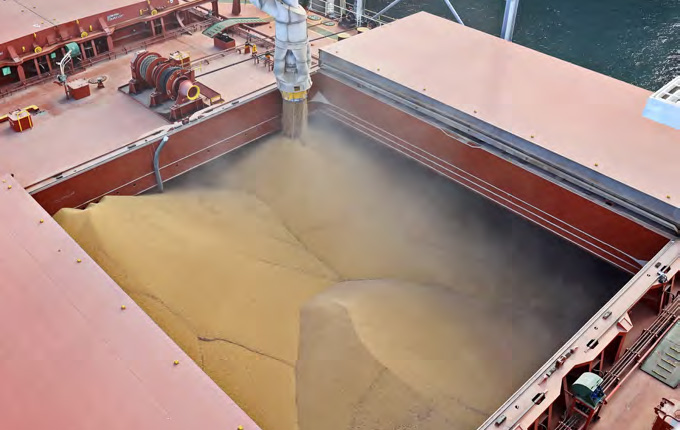
Clear photographs of the cargo and loading operations are also invaluable. These should include an overview of how the cargo was loaded, the cargo in the holds during loading and, where possible, close-up photographs of the cargo itself. A letter of protest should be issued to all concerned parties if any deteriorated, mouldy or wet cargo is identified. The Master has the right to reject the cargo for loading if it is in visibly poor condition. In the event a cargo quality issue may be suspected, it is also recommended that the cargo is representatively sampled according to sampling methods of the governing body specified in the commercial contract, i.e. the Grain and Feed Trade Association (GAFTA) for grains and animal feeds or the Federation of Oil, Seeds and Fats Associations (FOSFA) for oilseeds.
Analysis of representative samples from load port may become crucial evidence in the event of a claim.
The Master and Chief Engineer should consider the location of heated Fuel Oil tanks (FOTs) prior to loading and, if possible, stow cargo away from heated FOTs. If the cargo is stowed adjacent to the FOTs, the Chief Engineer should be instructed to ensure that fuel oil is heated to the minimum pumpable temperature. A record of this
instruction could prove valuable in defending a claim for over-heating of the fuel oil as well as keeping concise fuel oil temperature records.
Fumigation
Grain and oilseed cargoes are usually fumigated on completion of loading. The fumigation is typically for in transit fumigation although sometimes the cargo may be fumigated ashore prior to loading or on arrival at the destination. Masters should familiarise themselves with the IMSBC Code Supplement MSC.1/Circ.1264 (27 May 2008) as amended by MSC.1/Circ.1396 Recommendations on the Safe Use of pesticides in Ships Applicable to the Fumigation of Cargo Holds.
The fumigator should provide the Master with documentation describing the type of fumigant, the method of application, the dosage and duration of exposure. The quantity of fumigant should be calculated based on the total volume of the hold and not the quantity of the cargo.
In addition to this information, appropriate safety equipment and instructions should be provided to the Master relating to crew safety during fumigation. This should include the ventilation requirements to ensure the holds are gas free.The two most commonly used fumigants for fumigation of bulk grain and oilseed cargoes are aluminium phosphide and methyl bromide. The latter tends to be used for quarantine purposes rather than standard fumigation of grains and oilseeds. While aluminium phosphide (phosphine) can be used- in transit, holds should only be fumigated with methyl bromide if the vessel remains in port at anchorage or berth and the crew should be removed from the vessel.
Aluminium phosphide reacts with moisture to produce phosphine gas. The fumigant is applied in tablet or pellet form. It may be applied packaged to allow easy removal of the fumigant residue before discharge. The crew should document the fumigant application from a safe distance and ensure that the fumigators are applying the fumigant to the method stated on the fumigation documentation.
The standard phosphine fumigation exposure period, during which the holds must remain sealed, is not fixed and may vary between 3.5 and 18 days. The most commonly seen fumigation exposure period for bulk grain is usually 10 days. In some instances, the Master may be advised not to ventilate the hold for a significantly longer period of time and occasionally for the entire voyage (particularly when grains are loaded and fumigated in the USA). If this is the case, owners are recommended to contact their charterer immediately, as a long fumigation exposure period does no
consider changes in environmental conditions that might result in condensation and cargo surface damage.
Following the completion of the fumigation exposure period, the holds should be ventilated in accordance with the fumigation instructions to ensure that any remaining fumigant gas is dispersed. It is strongly recommended that a fumigation company is appointed prior to discharge in order to check the fumigant gas levels and issue a Gas Free Certificate. No personnel should ever enter a cargo hold which has not been confirmed as gas free and safe to enter after fumigation.
-
3. During voyage
Ship’s sweat and cargo sweat are types of condensation that form within the hold due to changes in environmental conditions. Condensation can result in a localised increase in the cargo moisture content. This places the affected cargo at risk of deterioration and mould growth with an associated rise in temperature. Further discussion on the effects of ship’s sweat and cargo sweat on the cargo can be found in the section Risks associated with carriage below.
When ventilating bulk hygroscopic cargoes such as cereals and oilseeds, it is recommended that the ‘three degree rule’ is used. The rule prescribes that ventilation should occur when the outside ambient temperature is more than 3°C below the temperature of the cargo at loading and the weather conditions are suitable. If the vessel experiences a significant delay prior to discharge, however, it may be possible to re-measure the cargo temperatures at this stage.
4. During discharge
In most circumstances, discharge of bulk grain proceeds without incident. In the event of damage at discharge it is important that the position of damage in the hold or holds is accurately recorded. This will assist in determining the cause of damage. The crew should closely monitor discharge and any segregation activities. A local surveyor should be appointed to document cargo condition, inspect the damage and, where relevant, obtain a cargo temperature profile throughout discharge.
A sampling superintendent should also be appointed to take representative samples of the grain during discharge. Ideally, the sampling should be performed on a joint basis with other interested parties. The representative samples obtained should represent the cargo as a whole and any segregated categories (i.e. additional representative samples should be obtained for cargo considered sound and damaged).
5. Risks associated with carriage
Condensation – ship’s sweat and cargo sweat
Ship’s sweat forms when the steelwork of the vessel is cooler than the dew point of the air within the headspace. This typically occurs when a vessel sails to a cooler climate and the lower external ambient temperature cools the steelwork. As a result, the water vapour within the hold headspace condenses onto the steelwork and then drips on the cargo surface/runs down the frames of the hold. This damage is characterised by wetting and associated mould damage visible as a regular repeating pattern across the surface of the cargo reflecting the frames of the hatch covers directly above. Repeated wetting due to prolonged formation of ship’s sweat can result in damage extending deeper into the stow.
Cargo sweat forms when the cargo temperature is lower than the dew point of the air in the headspace. This normally occurs in situations where cold cargo is loaded and warm air is subsequently introduced into the headspace by incorrect ventilation during a voyage or when a cold cargo is discharged in a significantly warmer destination. In this case, the condensation forms directly on the surface of the cargo itself. This damage would be characterised by a mould growth at the surface of the stow.
Cargo sweat can also occasionally occur when there is prolonged ventilation of the holds with air that is far lower than the cargo temperature. This can reduce the cargo temperature of the immediate surface layer. If there is a subsequent delay in discharge, moisture from the bulk of the stow may rise and condense against the cooled cargo at the surface.
Water ingress
Water ingress through hatch covers commonly presents in the form of obvious columns of mould damage and caked pillars of grain where the water has leaked directly downwards from the point of entry.
- The only preventative measure is to ensure that all hatch covers and manholes are checked regularly to ensure water tightness. The condition of the steel compression bars and rubber hatch cover seals should be regularly checked and maintained accordingly. Ideally, the crew should ensure that a hose or ultrasound test is performed prior to the voyage.
- Ingress through the hatch covers may also occur if the holds are left open when there is spray on deck during the voyage. If ingress occurs at loading, wetted cargo must be discharged. Failure to discharge wetted cargo at the load port is likely to lead to cargo claims at the discharge port due to visible mould growth. To prevent these issues, the Master and crew should pay close attention to the weather and be ready to close hatch covers if required.
- Severe weather conditions during the voyage with seawater on the deck can also result in ingress via hatch covers or open ventilation windows. A sea protest with details of the weather event should be issued on arrival at the destination.
- Mould and wet damage at the lower part of the hold are often attributed to overflowing and poorly maintained bilges. A surveyor or crew member should closely inspect the condition of the bilges prior to loading cargo to ensure that wastewater can be easily removed.
- Furthermore, the bilge levels should be measured and recorded regularly during the voyage and, if necessary, water pumped out to prevent overflow of the bilges. Once discharge of each hold has been completed, the bilges should be inspected for any signs of water accumulation.
Self-heating
Wholegrain and oilseed cargoes carried in bulk, e.g. wheat, barley and soya beans, still undergo biological reactions during storage. The grains continue to slowly respire, consuming oxygen and generating carbon dioxide, water and heat. Due to the large quantity of cargo within the holds and the high insulation capacity of such cargoes, the grain/oilseed temperature can slowly increase over time. Fortunately, when carrying cereal grains, the rate of respiration is very low, and the temperature increase is therefore normally minimal. The degree to which self-heating will manifest itself within a cargo is influenced by the moisture content and temperature of the cargo at loading and the length of the voyage. In some cases, pockets of cargo with a high moisture content will begin to develop mould, further heating the cargo. If the entire cargo has an inherently high moisture content, the risk of mould growth and selfheating increases significantly.
Carriage of cargoes with a high oil content or processed feed products with residual oil content have an additional risk of self-heating due to breakdown of the oil. As a result, there is a greater risk of oilseeds and seed cake cargoes self-heating in comparison to cereal grain cargoes. If such cargoes have been stored on board for a long time, it is not uncommon for temperatures to exceed 50 °C. In severe cases of heating the product may severely discolour and carbonise.
There are a number of other potential sources of heat which can initiate the self-heating process. A common source of heating is insect infestation. Insects, like other living organisms, generate heat as a by-product of their metabolic processes. A significant insect infestation can lead to rapid increase in temperature and damage to cargo. It should also be noted that insect infestation will also cause physical damage to the grain and contamination.
Other external heat sources include cargo lights, improperly fitted fumigant recirculation fans inside the hold, and heated FOTs adjacent to the holds. These external heat sources generate localised heating which can initiate the self-heating process.
In the event of self-heating, there is little that can be done to stop the continued increase in temperature. Ventilation only serves to remove warm moist air from the headspace and does not affect the temperature of cargo within the body of the stow.
The only truly effective method to mitigate self-heating is to discharge the cargo as soon as possible. Self-heating may continue post-discharge if the cargo is stored in large piles with little ventilation.
Conclusion
There is a wide range of considerations for the crew to consider prior to and during the carriage of bulk grain or oilseeds. An understanding of the common issues experienced during carriage of these cargoes and ways to avoid these issues may well assist in preventing cargo damage and claims.
Loss Prevention Essentials
- Ensure hold cleanliness before loading.
- Perform ultrasound or hose test before loading.
- Measure cargo temperature during loading.
- The cargo should be ventilated in accordance with the three degree rule during the voyage.
- Keep a record of pattern/location of any damage. Clear photographs of all stages of the cargo operations provide good evidence in case of a claim.
Prepared in collaboration with CWA International
Downloads