Introduction
Bulk cargoes containing fine particles and some moisture have a propensity to ‘liquefy’, resulting in stability problems that in the worst cases can capsize a vessel.
Liquefaction is a phenomenon in which bulk cargoes are transformed from a solid dry state to an almost fluid state and behave like liquids when the vessel is moving. Examples include granular cargoes such as iron ore fines, nickel ore and mineral concentrates.
Such cargoes, which fall under the IMSBC Code 2020 Edition (the Code) Hazard Classification of Group A, are at risk if shipped with a moisture content in excess of their Transportable Moisture Limit (TML). Appendix 1 of the Code contains individual schedules for Group A mineral cargoes.
Although the number of incidents involving liquefaction have fallen over the past few years, the shipping industry must remain alert for this phenomenon as moisture related cargo failure continues to result in losses of ships and the death of seafarers.
While not exhaustive, the guidelines below should assist when loading and carrying Group A cargoes:
The Code provides the following definitions for moisture content, Flow Moisture Point (FMP) and Transportable Moisture Limit (TML):
Moisture content means the portion of a representative sample consisting of water, ice or other liquid expressed as a percentage of the total wet mass of that sample.
Flow Moisture Point means the percentage moisture content (wet mass basis) at which a flow state develops under the prescribed method of test in a representative sample of the material (see paragraph 1 of appendix 2)1.
Transportable Moisture Limit (TML) of a cargo which may liquefy means the maximum moisture content of the cargo which is considered safe for carriage in ships not complying with the special provisions of 7.3.22. It is determined by the test procedures, approved by a competent authority, such as those specified in paragraph 1 of appendix 21.
Pre-loading criteria
An independent cargo surveyor should be appointed to assist in determining that the cargo is safe to load, i.e. the moisture content of the cargo is less than its TML.
Loading should not start until valid certification for TML and moisture content has been provided, signed and issued by an entity recognised by the Competent Authority of the port of loading.
Valid certification for Group A cargoes must accompany the Cargo Declaration Form provided by the shipper (Section 4.2 of the Code).
Under Section 4.3.3 of the Code an additional certificate is required from a Competent Authority of the port of loading. This must state that the Competent Authority has approved and checked the implementation of the shipper’s procedures for sampling, testing and controlling moisture content, to ensure that the moisture content of the cargo is less than the TML when it is on board the ship. Section 4.3.3 is often overlooked by shippers but is mandatory and therefore should be provided to the Master prior to loading.
In addition, the information on the likelihood of formation of a wet base (Section 7.2.3 of the Code) is required from the shipper on the Cargo Declaration.
A full list of Information required for the Cargo Declaration Form provided by the shipper is given in Section 4.2.2 of the Code.
Moisture Certificate for the cargo to be loaded
The shipper must provide the Master of the vessel with a dated and signed certificate for the moisture content of the cargo to be loaded.
The moisture content certificate must identify the stockpile(s) sampled. The appointed surveyor should check that the samples which are tested are representative of the cargo to be loaded.
The interval between sampling/testing for moisture content and start of loading must never be more than seven days.
TML Certificate for the cargo to be loaded
The shipper must provide the Master of the vessel with a signed certificate for the TML of the cargo to be loaded. The TML certificate must not be older than six months at the time of loading. If the composition or characteristics of the cargo have changed since the last test, even if it is less than six months old, a new TML certificate must be issued.
Check that the TML equates to 90% of the flow moisture point (FMP) in the case of the Flow Table Test and the Penetration Test. This 10% safety margin allows for uncertainties in sampling, testing and variation in the moisture content.
For the Proctor/Fagerberg Test, the TML of a cargo is taken as equal to the critical moisture content at a 70% degree of saturation according to the test (Appendix 2, Section 1.3 of the Code). There are separate Modified Proctor/Fagerberg Tests for iron ore fines, coal and bauxite cargoes, with different criteria for the TML (Refer to Appendix 2, Sections 1.4, 1.5 and 1.6 of the Code).
-
Loading Operations
Section 4.4.3 of the Code states that ‘For a concentrate or other cargo which may liquefy, the shipper shall facilitate access to stockpiles for the purpose of inspection, sampling and subsequent testing by the ship’s nominated representative’. If there is any doubt regarding the validity of the certificates and/or the suitability and safety of the cargo to be loaded, the appointed surveyor should take samples from the designated stockpile(s) for testing in an independent recognised laboratory for TML and moisture analysis. Guidelines for stockpile sampling are given in Section 4 of the Code.
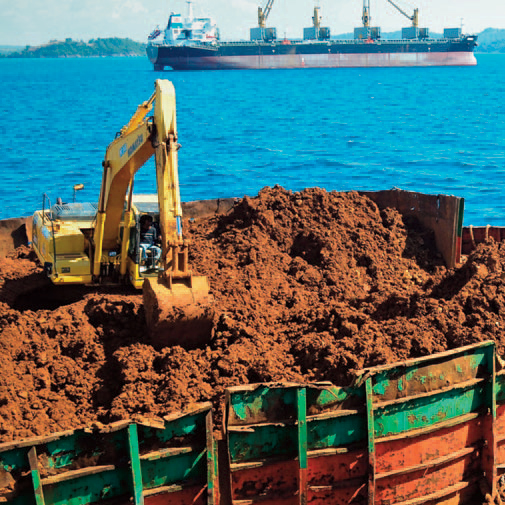
The appointed surveyor should check that the stockpile(s) and barges to be loaded are properly covered with tarpaulins. If it rains, then loading operations should be suspended and the hatch covers closed. If the cargo to be loaded has been exposed to significant precipitation between the time of sampling/testing and before completion of loading, then the shipper must conduct further laboratory tests to ensure that the moisture content is still below the TML and provide a new moisture certificate prior to resuming loading operations. Even when the stockpile(s) are adequately covered with tarpaulins, there is still a risk that the stockpile base may not be sufficiently covered and rainwater may pool at the bottom of the stockpile(s). The bottom material should be sampled separately and tested for moisture content prior to loading.
Crew members must be trained to carry out ‘can tests’ regularly during loading operations (Section 8 of the Code). Although it is a rudimentary test, if free moisture is visible on the surface of the sample at the end of the test, arrangements should be made to have additional moisture tests conducted in the laboratory on the material. The ‘can test’ should not be relied upon exclusively. It is not quantitative and only indicates whether the FMP of the cargo has been exceeded. Even if the ‘can test’ is a pass, the moisture content of the material may still exceed the TML.
Barges which fail can tests should be rejected. Loading must not resume until the surveyor has taken representative samples, to internationally or nationally accepted sampling standards, of the remaining cargo for determining the moisture content at an independent recognised laboratory. Loading should only resume when the laboratory results show that the moisture content is below the TML.
Special attention should be paid to cargo loaded during the night shift as it is not without precedent that attempts have been made to load suspect cargo during the night.
Ensure the cargo is trimmed evenly, which reduces the likelihood of the cargo shifting.
During the voyage
Bilge soundings should be taken daily during the voyage as some cargoes are liable to moisture migration and the formation of a hazardous wet base and sliding or shifting of cargo. A wet base may form even if the moisture content is less than the TML.
The appearance of the surface of Group A cargoes should be inspected regularly during the voyage3. If free water is observed above the cargo surface or the cargo is in a fluid state, the Master should instigate procedures to prevent cargo shifting or listing. The Master should also consider emergency entry into the nearest port or place of refuge.
Loss Prevention Essentials
- An independent cargo surveyor should be appointed to assist in determining that the cargo is safe to load.
- Loading should not start until valid certification for TML and moisture content has been provided, signed and issued by an entity recognised by the Competent Authority of the port of loading.
- A valid certification for Group A cargoes must accompany the Cargo Declaration Form provided by the shipper. An additional certificate is required from a Competent Authority of the port of loading. This must state that the Competent Authority has approved and checked the implementation of the shipper’s procedures for sampling, testing and controlling moisture content.
- If there 1is any doubt regarding the validity of the certificates and/or the suitability and safety of the cargo to be loaded, the appointed surveyor should take samples from the designated stockpile(s) for testing in an independent recognised laboratory for TML and moisture analysis.
- Bilge soundings should be taken daily during the voyage.
- If free water is observed above the cargo or the cargo is in a fluid state, the master should instigate procedures to prevent cargo shifting or listing and consider emergency entry into the nearest port or place of refuge.
Prepared in collaboration with CWA International
1Paragraph 1 of Appendix 2 of the Code lists six methods of testing for TML which are currently in use – Flow Table Test, Penetration Test, Proctor/Fagerberg (PF) Test, Modified PF Test Procedure for Iron Ore Fines, Modified PF Test Procedure for Coals and Modified PF Test Procedure for Bauxite.
2IMSBC Code 2020 Edition Section 7.3.2 “Specially constructed or fitted cargo ships for confining cargo shift”
3Refer to the revised recommendation for entering enclosed spaces aboard ships (Resolution A.1050 (27)) (Supplement in IMSBC Code 2020 Edition).
Downloads