The vessel was alongside at its first port of call following completion of a dry-dock. With favourable weather conditions, the Master decided to conduct a man overboard drill and instructed the Chief Officer to prepare the rescue boat after lunch.
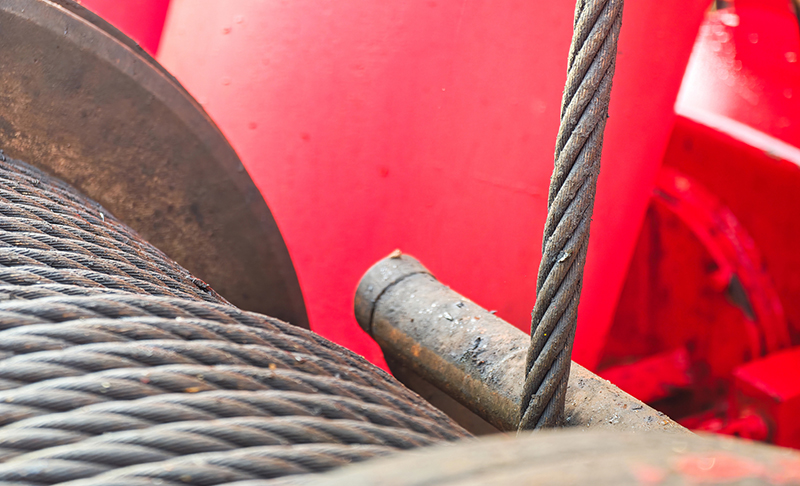
During the dry-dock period, the davit wire for the rescue boat had been replaced. Prior to docking, the Chief Officer had ordered a new wire; however, the delivered wire was 2 mm smaller in diameter than the original. The Chief Officer accepted the deviation, assuming it would be adequate, and did not verify its suitability against manufacturer requirements or operational loads. He was also unaware that the installed davit winch motor had a capacity exceeding what the reduced-diameter wire could safely withstand.
While in dry dock, an electrician had also replaced a fuse in the winch motor circuit board. The replacement fuse had a significantly higher amperage rating than the original, removing an important safeguard against overload conditions. In addition, the electronic proximity switch, designed to stop the winch motor before the davit arm reached its stowed position, had become inoperative. Moisture had entered the unit, likely during routine washdowns using a high-pressure hose, leading to internal damage and a short circuit. The vessel’s Safety Management System required this proximity switch to be tested prior to use of the rescue boat, but no such test was carried out. The system was designed with only a single proximity switch, providing no redundancy.
Following lunch, the rescue boat crew mustered at the launching area. A briefing was conducted by the Second Officer, who was part of the rescue boat crew together with two ABs. The Bosun operated the davit winch, while the Chief Officer supervised from deck level and the Master monitored the operation from the bridge. The crew boarded the rescue boat in its stowed position, wearing appropriate personal protective equipment and securing their safety harnesses to designated attachment points.
The Bosun commenced lowering the rescue boat at slow speed and, once the davit was fully extended, increased to high speed. The boat entered the water without incident, the engine was started, and the hook was released. The drill proceeded as planned, and the boat returned to the vessel to be hoisted back to its stowed position.
During recovery, the Bosun initially hoisted the boat at high speed and then reduced to slow speed as it approached deck level. The crew remained in the boat, as the plan was to disembark only once it was fully stowed. As the boat was hoisted towards the stowed
position, the Bosun relied on the proximity switch to automatically stop the winch motor before the davit arm reached its limit. However, as the proximity switch was not functioning, the motor continued to run. Instead of stopping, the system applied increasing load to the wire. The absence of a correctly rated fuse allowed the motor to deliver excessive power.
The resulting overload caused the davit wire to fail suddenly. The rescue boat fell from a height of more than 20 metres into the water, with the three crew members still inside.
All three crew members sustained serious injuries. Manufacturer guidance specified that the winch operation should be stopped manually before the proximity switch is activated. However, there were no clear visual markings or indicators on the davit structure to assist the operator in identifying the correct stopping position.
Questions
When discussing this case please consider that the actions taken at the time made sense for all involved. Do not only judge but also ask why you think these actions were taken and could this happen on your vessel?
- Does our SMS address these risks?
- What sections of our SMS would have been breached if any?
- Do we have a risk assessment onboard that addresses these risks?
- Would a work permit have identified these risks?
- The risk of serious injuries increases substantially with the height from where a survival craft is launched. What is the height for our survival crafts?
- Have we considered wearing a retractable fall arrestor connected to the jib or other certified point?
- Do we board the rescue boat in the stowed position, at deck level or at main deck?
- Do we check the davit proximity switch before the boat is used?
- Are the davit limit switches included in the PMS?
- It is very important to monitor sensitive electronic equipment on deck and ensure that it is not washed down or painted over. Is this addressed onboard our vessel?
- Are we aware of the winch motor’s capacity and the required diameter for the wire?
- What additional training or practical drills could help the crew be better prepared for a situation like this?
- What support do we need from management (additional training, updated procedures, more
resources) to strengthen our procedures? - What immediate, actionable steps can we take from today’s discussion?
Downloads