Introduction
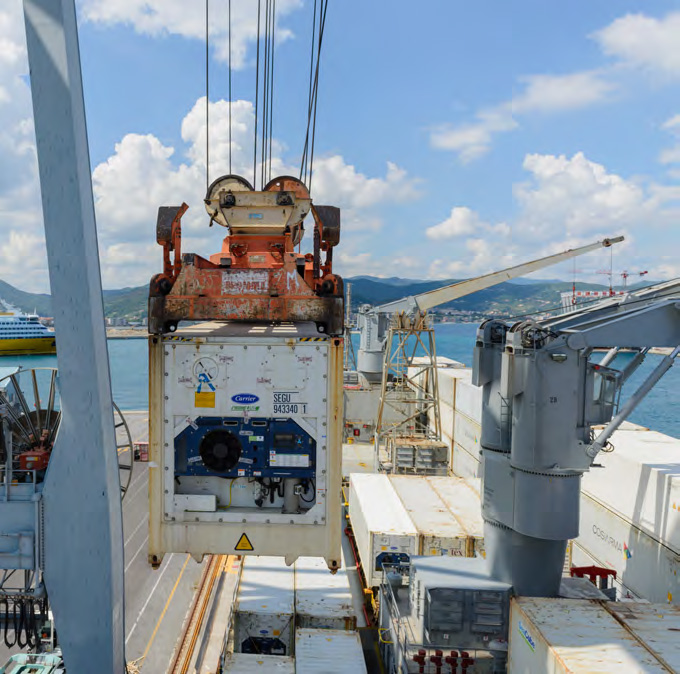
A wide variety of refrigerated goods are carried in reefer containers of which fresh produce, frozen meat & fish, dairy products and pharmaceuticals are only a few. A single reefer container may carry a cargo value of several hundred thousand US dollars or more.
Each type of cargo varies in its requirements for carriage temperature, humidity, stowage arrangements and ventilation. For example, for frozen and chilled goods the aim is maintain the product temperature and circulate cold air around the edges of the cargo to reduce the possibility of temperature variations at edges of the stow caused by extreme ambient temperatures. When carrying frozen cargo, the fresh air ventilation ducts should always be closed. In contrast, for chilled live cargoes such as fruit and vegetables the products should be stowed to allow air flow to circulate throughout the cargo stow, thus the cooling will remove product heat, as well as moisture and gases such as carbon dioxide and ethylene. The exact ventilation requirements will depend on the type of product carried.
For all these cargoes, it is important to note that the reefer container is designed to maintain the cargo temperature rather than cool it. Ideally, all cargoes should be loaded at the intended carriage temperature to ensure product quality is maintained.
Guidelines for the carriage of refrigerated cargoes
1. Pre-loading
It is often the case that containers are loaded and sealed without the crew being able to verify the type or condition of the contents. It is of utmost importance therefore that crew are fully aware of the carriage instructions prior to loading so that the container temperature and ventilation settings can be verified before the container is accepted on board.
2. During loading
The crew should check that the container set temperature complies with the shippers’ specified carriage instructions. The external integrity of the reefer container should also be checked for damage with any defects noted and photographed. The shipper should be notified of any physical damage to the container. If the delivery or return air temperatures are incorrect it is important to confirm with the shippers that any adjustment to the correct set temperature will not lead to cargo damage during the voyage.
3. During voyage
Unlike bulk cargoes, where damage may be immediately apparent when discharge commences, damage to cargo in containers whether dry or refrigerated will only likely be found at the destination when the container is emptied. Proper container monitoring and prompt action during a voyage will provide helpful information as to whether the carrier should appoint a surveyor to be present for opening of the container at the destination. The condition of cargo at destuffing will provide useful information to determine the most likely cause of damage to the cargo.
Continuous supply of power to the reefer containers is also of utmost importance during the voyage. The vessel’s crew should regularly monitor this and ensure that all incidents regarding the vessel’s diesel generators and reefer circuit breakers and their associated alarm systems are meticulously recorded. It is also important to check that the defrost cycles are taking place at regular intervals in order to ensure that there is no build-up of ice on the evaporator coils which would cause malfunction of the refrigeration system. Proper container monitoring and record keeping during the voyage are important. The records provide vital evidence in case of claim.
4. Risks associated with carriage
Some typical problems related to refrigerated carriage include:
- Hot loading: Reefer containers are designed to maintain cargo temperature rather than lower the cargo temperature. Despite this, some cargoes are often loaded at ambient temperature and subject to later claims for temperature abuse.
- Temperature abuse: This covers a variety of possible issues; for example, power supply problems may cause fluctuations in delivery temperature or an incorrect temperature set point, exposing cargo to the wrong delivery temperature. Temperature abuse affects cargoes in different ways depending on the cargo. For fresh or frozen products these might include premature ripening, freezer burn, frosting and textural changes.
- Airflow: Poor airflow/ventilation through the cargo can lead to temperature hotspots developing. This can be due to poor stowage or packaging of cargo preventing airflow through the cargo or over stowage of cargo preventing return air to the refrigeration unit. Poor airflow might also be caused by condensation freezing and blocking the T-bar floor. These typical issues can affect types of cargo differently. The following example cases highlight some of the effects of the above problems on different types of commodities.
-
Case studies
Fresh/frozen meat – chilled beef
A cargo of chilled beef cuts was loaded onto a container and carried at a set point of -1.4 °C. The container was discharged and stored ashore whilst awaiting loading to a feeder vessel. The set temperature ashore was also -1.4 °C. The container was then loaded to a feeder vessel where the set temperature was amended to -14 °C until the container was discharged. The chilled beef was carried at the far lower temperature for almost two days.
Meat freezes at temperatures between -1.5 °C and -1.8 °C. The minimum shelf life of good quality vacuum packed beef cuts can be between 10 and 12 weeks if maintained between 0 °C and -1.4 °C provided that good hygiene practices and temperature control are maintained during slaughter, processing, packaging and final storage.
If the temperature of chilled meat falls below -1.4 °C during storage it can cause muscle cell rupture due to the slow formation of large ice crystals. This in turn leads to blood serum separation making the meat less attractive to the customer and more susceptible to microbiological deterioration. Frozen meat is typically blast frozen producing small water crystals thus avoiding such cell rupture and the associated textural changes. In this case, the amendment of the set temperature to -14 °C rather than -1.4 °C led to slow and partial freezing of the meat. There were clear examples of blood separation from the meat found in some of the cartons, indicative of the meat having been slowly partly frozen.
In such cases, it is important that the cargo is inspected at discharge since not all cartons of meat would be affected. The cartons at the edges of the stow would be most affected by change in temperatures since these cartons would be most exposed to the cooling air.
Fresh/frozen fish and seafood – shrimps
A shipment of containerised boxed shrimps shipped from Argentina to China was found to be badly frosted. The shrimps inside the boxes were also beginning to blacken due to melanosis.
Shrimps and crustacea undergo melanosis (an enzyme catalysed oxidation) when they are kept at incorrect temperatures and/or past their shelf life. Melanosis is also related to the freshness of the product at the time of freezing and whether it has been treated with any preservatives. While melanosis is not dangerous for consumption, it is a quality control indicator, and renders the shrimps unsightly and unsaleable.
The frosting is a second indicator that the product had suffered temperature abuse. Frosting appears when a product is thawed and then partially refrozen. Usually, the boxes are tightly packed into the containers, restricting airflow through the cargo and effectively insulating the cartons inside the stow compared to the ones in the outside. The product on the inside of the stow would be insulated against the worst damage by the cargo around it. It is then expected to observe a gradient of damage as the condition of the cartons is poorest nearest the door and the external edges of the stow, with the damage lessening towards the rear of the container. The cargo should always be kept below the load line of the container, away from the container walls and not beyond the T bars to allow the refrigerated air to flow freely around the whole of the stow.
The container logs showed erratic temperature changes. Seven days after the start of the voyage, the temperature started to rise slowly but steadily from -25 °C to a range between -10 °C to -2 °C at arrival, which is indicative of a refrigeration system malfunction. These temperatures are sufficient for melanosis and frosting to occur. The Master and the crew should have been warned of the malfunction and attempted to repair the container; however, the corresponding alarms were not relayed to the vessel, suggesting a secondary malfunction in the system.
Dairy – butter
Containers carrying frozen butter at -18 °C were discharged and left unplugged in high ambient temperatures for about three days.
Butter is a water-in-oil emulsion. It has a unique texture and mouthfeel which results from careful working or kneading at specified temperatures during the manufacturing process, to establish a fat crystal network containing fine water droplets. Butter should have a uniform colour, be dense and taste clean. The water droplets should be fine and dispersed well so that the butter looks dry. The consistency should be such that the product is easy to spread and melts readily on the tongue.
If butter is to be frozen for long term storage or transport it must be cooled rapidly to avoid the formation of large fat crystals which can impair its smoothness and spreadability. Fluctuations in storage temperature can lead to changes in fat crystal structure and emulsion. These changes affect texture and storability of the butter.
In this case, the data loggers recorded that the delivery air temperatures were all lower than the return air temperatures. Some container logs included cargo temperature data which indicated that the cargo temperatures were significantly lower than the delivery air temperatures at the time. This suggested that the air in the container was being warmed and this could only be caused by environmental conditions outside the container, despite the normal insulation of the reefer containers. Parts of the cargo were reportedly found obviously damaged and the cargo was rejected. Given the temperature data, it was apparent that butter at the peripheries close to the walls and end of the containers, especially those directly exposed to the sun, changed in temperature and began to melt, releasing oil and staining the packaging.
In this situation, since the container was returned to power and cooling resumed, the centre of the cargo was likely to be unaffected but the whole consignment was rejected.
Fresh produce – garlic
A cargo of bagged white garlic was shipped from China to Central America. On arrival, it was noted that significant portions of the consignment showed signs of germination.
After curing (a process of drying after harvest), garlic can be stored at high temperatures (25 °C) or low temperatures (-3 °C to 0 °C) to prevent germination of the bulbs and maintain the storage life of the product. Temperatures above 5 °C and below 20 °C are not appropriate for garlic storage and can cause dormancy break, advanced germination, and fungal/bacterial issues. It is common to see garlic transported in containers at low temperature (i.e. -3 °C to 0 °C). At these lower temperatures, the heat generated by respiration of the garlic bulbs is removed, helping to maintain a period of dormancy.
In this case, it was apparent that the required set point temperature of 0 °C had not been applied, since the temperature records indicated that it took several days for the temperature to reach 4 °C. Furthermore, the situation was exacerbated by the cargo being ‘hot-loaded’, meaning that the cargo was not pre-chilled before loading. The effect of these two factors was to prevent the cargo from meeting the required temperature range and thus, led to a significant portion of the cargo arriving with unacceptable levels of germination.
The crew should take care when checking that set point temperatures, as outlined in the carriage instructions, are properly applied to the containers. A failure to do so can lead to the onset of germination and/or spoilage of cargo through bacterial or fungal infections.
Fresh produce – mangoes
Palletised cartons of mangoes were pre-cooled to 10 °C/11 °C before loading on to containers. Mangoes in good condition cooled to such a temperature range can be expected to have a storage life of 3 to 4 weeks.
On arrival at the destination, the fruit was found in variable condition. Some mangoes were hard and sound, whilst others were soft, presenting with disease symptoms on the skin. There were also examples of visible harvest injuries and internal defects.
Review of the temperature data loggers placed in each container indicated that the cargo was subjected to post-stuffing temperature abuse. In all containers, the delivery air temperature (DAT) was noted to be above the requirement of +10 °C stated in the carriage instructions. The DAT ranged between 18 °C and 29 °C. It took between 3 and 7 days for the temperatures in the containers to reach the required temperature range.
In this case, it was independently verified prior to stuffing of the containers that the fruit was pre-cooled and already at the appropriate temperature range. This clearly showed that the outturn condition of the fruit was not related to hot loading and subsequent slow cooling.
The temperature data indicated that there were fluctuations in DAT above the carriage instructions. The changes in DAT were related to fluctuations in power supply which prevented maintenance of continuous cooling. The high delivery temperature inevitably led to increased rate of ripening and deterioration which was obvious at the destination. This was evident as a large proportion of the fruit was found to be soft and affected by fungal diseases. Both ripening and growth of fungal organisms would have been slowed by carriage at the requested transit temperature.
Conclusion
The most important point for carriers is to ensure that the carriage instructions and set temperature are checked and adhered to at the time the reefer container is loaded. In the event of a claim, one of the most effective defences is the maintenance of clear and accurate records and documentation of each stage of the voyage from loading through to discharge. For reefer containers, the crew can assist by maintaining detailed and accurate monitoring and maintenance logs as well as obtaining date stamped photographs of incidents which occur during the voyage.
Loss Prevention Essentials
- Ensure compliance with the shippers’ carriage instructions. If these are unclear, seek clarification.
- When loaded, make sure that the container’s set temperature complies with the carriage instructions.
- Keep clear and accurate records of temperature, ventilation, and other relevant aspects. The records must cover each stage of the voyage, from loading to discharge.
Prepared in collaboration with CWA International
Downloads