Introduction
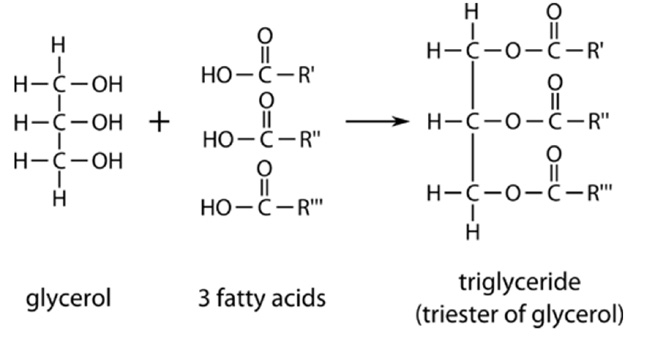
Vegetable oils and fats are extracted from fruits and seeds, with their composition varying depending the type and/or source of the fruit or seed. The terms fat and oil are defined based on their consistency at room temperature, with oils being liquid at room temperature and fats being solid. In general, vegetable oils consist predominantly of triglycerides. These are compounds composed of three fatty acids bonded to a glycerol molecule:
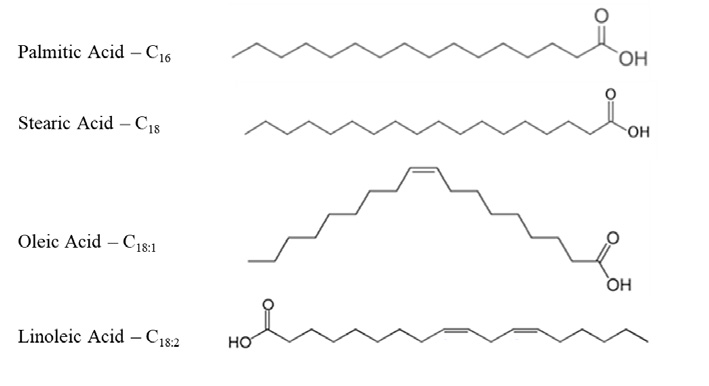
The triglycerides present in vegetable oil consist of a range of fatty acids of different carbon chain lengths, such as those shown in the diagram below. Vegetable oils normally contain fatty acids between 12 and 26 carbons in length.
Edible oils can be shipped as either crude vegetable oils or refined products.
Crude vegetable oil is the product obtained from the initial extraction of a vegetable source which has undergone no further processing or refining. It is important to establish whether the crude oil being carried has been through the ‘degumming’ process. This is where the crude oils are washed to remove impurities such as organo-phosphorous compounds more commonly referred to as gums. This is an important factor when considering the carriage conditions.
Crude vegetable oil often undergoes further refining to produce refined products. The first stage of refining for palm oil products involves the crude oil being refined, bleached and deodorised, often referred to as RBD.
Bleaching is the process whereby impurities, particularly coloured compounds known as carotenoids in the case of palm oil, are removed from oils and fats. This is carried out using adsorption with clays or activated carbons. Deodorisation of vegetable oils is the removal of trace compounds which give rise to odours and flavours which could make the product less marketable for some uses.
Refined sunflower oil is denoted as refined, winterised and deodorised (RWD) and refined soyabean oil denoted as degummed, refined, deodorised.
Guidelines for the shipment of vegetable/edible oil cargoes
1. Pre-loading
Edible oils are commonly shipped under FOFSA contracts. Not only does FOSFA provide guidance regarding contracts covering goods being shipped, but also provides guidance regarding cargo tank inspections and assessing tank suitability for carriage of products shipped under FOSFA contracts. These are covered in the FOSFA ‘Combined Masters certificate’ and FOSFA ‘Certificate of compliance, cleanliness and suitability of vessel’s tanks’, respectively. FOSFA also issues a list of banned and acceptable previous cargoes in order to ensure that edible oil cargoes are not contaminated by unsuitable cargoes.
- Cargo handling systems: Heating coils should be made of stainless steel only; copper and alloys such as brass, bronze or gun metal are not permitted for use in any part of the cargo handling system with which the cargo has contact, e.g. piping, pipe connections, pumps, valves, heating coils, etc. Copper, and its alloys, have a strong catalytic effect on the oxidation of edible oils, resulting in the cargo quickly becoming rancid. This catalytic effect of copper can be seen even at sub ppm levels, hence it is vital that the cargo handling systems on vessels are completely absent of any traces of coper and copper alloys. Cargo lines should also be made of stainless steel with sufficient drain valves to ensure complete clearing and draining of the system.
- Coatings: Tanks, other than those constructed from stainless steel, should be coated with an appropriate coating system. Only coatings fit for food grade products and suitable for the carriage of the oil or fat to be loaded should be used. Blisters or loose splits in the coating should be opened and cleaned to ensure that no cargo residue remains. Areas of mild steel exposure in coated tanks should be minimal and any loose scale must be removed prior to loading.
- Residues: All previous cargo residues must be removed before loading edible oil, with any tank cleaning operations being performed in line with industry recommendations. Manufacturers of tank coatings and cleaning chemicals will also be able to advise on the compatibility of individual coatings and cleaning agents.
Are the vessel’s tanks suitable to carry the nominated cargo?
- What are the previous three cargoes carried by the vessel?
- Are any of these cargoes on the FOSFA banned list?
- Is the cleaning from the previous cargo in line with industrial guidelines, such as Dr Verwey’s or Miracle?
- During loading and discharge
Before transfer (either during loading or discharge), high melting point and high viscosity oils and fats should be heated so that they are kept fluid and completely homogeneous. Heating of the cargo should never exceed the maximum rate of 5°C in a 24-hour period, as set out by FOSFA. Rapid heating or overheating of the cargo can lead to heat damage/burning of the cargo directly adjacent to the heating coils. If steam heating coils are being used, the steam pressure should not exceed 150 kPa (1.5 bars) gauge to prevent localised over-heating.
Whilst all edible oils contain similar species, it is the composition of these species and the presence of other impurities that determines the grade of the product. As such, where possible, loading and discharge of different oils should be performed through segregated lines.
Co-mingling of two parcels of the same oil and grade is also not recommended due to oxidative quality reasons, as this may lead to a deterioration of quality of the combined parcel.
In the event that the multiple products are loaded/ discharged through a common pipeline system, it is recommended that the contents of the pipeline system are thoroughly cleared between the loading/discharging of the different grades.
In order to minimise the effects of the mixing of different grades of edible oil when loading/discharging through a common pipeline system, the following is recommended:
- Fully refined oils before partly refined oils
- Partly refined oils before crude oil
- Edible oils before technical grade oil
- Fatty acids or acid oils should be pumped last
Manifold, first foot and after-loading samples should be drawn during the loading of the cargo. Some terminals do not allow manifold samples to be drawn, therefore the rules and regulations of each terminal should be followed. Samples drawn during loading, in particular the manifold and first foot samples, can allow for a potential contamination issue to be caught early on and thoroughly investigated, possibly preventing or reducing contamination of the bulk cargo.
At the discharge port, before-discharge samples should be drawn as individual tank samples, either as running or upper, middle and lower level samples.
Guidance on sampling of oils and fats is provided in ISO 5555 and should be followed where possible to ensure representative samples are being drawn.
3. During voyage
The physical properties of the various types of edible oils vary significantly between oils, in particular the temperature at which the oil solidifies. This means that conditions for handling and storage of the cargo during the laden voyage cannot be standardised and must be considered and specified for each oil.
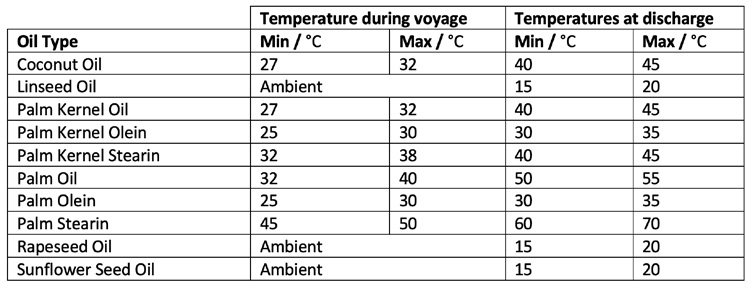
FOSFA provides specific carriage instructions for a range of vegetable oil cargoes as well as heating instructions to ensure the safe carriage of the product, examples of which are provided for some cargoes in the table below. The temperatures apply to both crude and refined oils in each type. In addition, as mentioned above, FOSFA guidelines state that a maximum heating rate of 5 °C per 24 hours should be adhered to when heating cargoes in preparation for discharge.
The characteristics of an oil cargo, in particular crude vegetable oils, may change while in transit due to natural sedimentation and separation of oil. For example, after some weeks in a tank, crude sunflower oil may have a deposit of sediment on the tank top and the oil may appear cloudy on discharge despite having been clear at the time of loading. In such circumstances it is likely that the oil has not been damaged, but a claim may be made when the appearance of the oil has changed between loading and discharge.
Edible oils consist of triglycerides from a variety of fatty acids, all of which have different carbon chain lengths and saturation and therefore different melting points. If the cargo is allowed to cool too much during the laden voyage, this may cause in fractionation of the cargo. This occurs when the longer and more saturated carbon chain species, which have higher melting points, solidify faster than the shorter or more unsaturated carbon chain species. This results in a portion of the cargo solidifying on the tank top and another portion of the cargo remaining as a liquid on top of the solidified oil.
Once fractionation has occurred, it is difficult to remelt the frozen oil, especially if the vessel is equipped with deck heaters. In such an event, other methods of heating the cargo would be required, such as spraying warm cargo into the tanks in order to melt the solidified cargo.
4. Risks associated with carriage
Free Fatty Acids (FFAs)
Rancidity is the development of off-odours and offflavours. This is caused by the formation of free fatty acids (FFAs) in vegetable oils. Whilst edible oils inherently have pre-existing levels of FFAs, these can increase during a laden voyage by a number of pathways. FFAs are produced when triglycerides are broken down and cause a fatty acid chain to separate from the glycerol backbone of the triglyceride. This breaking down of the triglycerides can be accelerated by the presence of water, exposure to heat or the presence of microbes. As such, careful control of the cargo temperatures and conditions should be ensured particularly for vegetable oil cargoes which require heating during voyage, such as palm oil.
However, it is also the case that short chain fatty acids produced from the breakdown of the triglycerides can serve as a catalyst themselves, leading to an auto-catalytic mechanism and further increasing the levels of FFAs. As a result, it is important to ensure that the level of FFAs in the cargo is kept to a minimum to avoid significant formation of FFAs via the auto-catalytic mechanism.
Contamination with water
Water contamination is another concern with edible oil cargoes, as the presence of water promotes hydrolytic rancidity and causes an increase in FFA levels. The presence of water can also lead to mould growth in the cargo, resulting in further increases in FFA level and cause the cargo to develop unpleasant odours and tastes.
As such, most edible oils have a limit for moisture content in place in order to keep the formation of FFAs to a minimum.
There are a number of sources by which water contamination of cargoes may occur, such as tank washing water left behind in cargo tanks prior to loading, and leakage of water/steam from in-tank heating coils as well as by ballast water leaking through cracks with adjacent ballast tanks. It is vital that a thorough inspection of the tanks, and testing of the heating coils is performed prior to loading as this will identify potential sources of water before any contamination takes place.
Temperature
Cargoes with melting points close to or above ambient temperatures such as edible oils require heating to ensure they stay sufficiently fluid to perform cargo operations and prevent short delivery or operational difficulties. However, in order to prevent overheating, strict control of temperatures is required to ensure a balance between fluidity and chemical stability, preventing both shortage and quality disputes.
Heating temperatures should therefore be strictly adhered to. Prior to loading, attention should be paid to the heating coils to ensure there are no leaks, as well as ensuring that the cargo tanks are dry. Temperatures of the cargos should be recorded daily to not only ensure that the appropriate carriage temperatures are maintained, but also to confirm that any cargo heating does not exceed the maximum limit of 5°C per 24 hours as set out by FOSFA.
Sensitivity to air
The presence of oxygen from the air leads to the oxidation of edible oils. Rancidity is the main effect but also changes in colour, viscosity, density and solubility take place.
Oxidation is essentially a reaction of oxygen with the double bond present in edible oils. This leads to a reduction of double bonds in the overall composition of the edible oil which results in the formation of peroxides. The secondary oxidation of these peroxide compounds affects the taste and odour of the edible oil, which results in rancidity.
The double bond composition in edible oils is represented by the ‘iodine value parameter’, therefore, a reduction in the iodine value of edible oils is an indication that oxidation has occurred.
Sediment
Vegetable oils are a complex mixture of compounds, and incorrect carriage conditions can lead to the formation of sediment, resulting in unpumpable quantities and short delivery. This can take place as a result of the following:
- Stratification: The cargo forms layers dependant on the density of the components, with the higher density components settling in the lower reaches of the cargo column.
- Fractionation: The heavier, higher melting point components of the oil freeze out of the bulk cargo, and are very difficult to remelt, as discussed above.
- Gum: If crude vegetable oil has not been degummed, then the gums present have a propensity to settle in the lower reaches of the cargo column and can result in a quantity of unpumpable material, referred to as residual on board (ROB).
This can be avoided by maintaining the correct carriage temperatures and recirculating the cargo during the carriage of oil.
As a result of ROB, the quality of the discharged oil may vary, such as melting point, and a shortage claim could arise.
Conclusion
Most voyages with vegetable/edible oil cargoes will be uneventful, but sometimes things go wrong. To minimise the risk of a claim of contamination resulting from the mishandling of the cargo, it is important that correct measures as described above are taken during loading, voyage and discharge.
Loss Prevention Essentials
- Do not exceed the maximum allowed heating rate of 5 °C per 24-hour period.
- Comply with the charterers’ heating instructions. If these are unclear, seek clarification.
- Follow carriage and discharge temperatures as detailed by the Federation of Oils, Seeds and Fats Association (FOSFA).
- Monitor the temperature of the cargo at upper, middle and lower levels through the cargo column at least once a day during the voyage to ensure compliance with heating rates and carriage temperatures.
- Recirculate the cargo if required, this may be particularly necessary for unrefined products.
Downloads