Introduction
Ventilation of bulk cargoes, especially agricultural commodities, is a recurring theme in claims brought against shipowners.
It is therefore important to understand what ventilation is, when it needs to be performed and the common issues associated with improper ventilation. In this article, we will discuss each of these subjects in relation to the transportation of bulk grains and oilseeds and we will try to clarify some common misconceptions.
What is ventilation?
Agricultural bulk cargoes are usually hygroscopic; they possess a natural moisture content, and they may absorb, retain or release moisture into the environment depending on the surrounding atmosphere. These cargoes usually retain the temperature at which they were loaded. The holds’ headspace and the interstitial airspace between the grains will naturally equilibrate overtime with the temperature and moisture content of the cargo, which can lead to condensation issues particularly if the loading port was in a relatively warm area.
This is where ventilation becomes important. It can be summarised as the act of replacing warm and humid air in the headspace with relatively cooler and dryer ambient air. The most commonly used ventilation on bulk carriers is natural ventilation (as opposed to mechanical ventilation). The hatch covers are usually equipped with a total of four ventilation windows with two windows forward and aft or two windows port and starboard.
Natural ventilation is a way of ventilating using the relative wind speed encountered during a voyage. It can be quantified by the number of Air Changes per Hour (ACH) experienced in the headspace. The ACH is impacted by different factors such as the wind speed, the quantity of free air in the headspace and the size of the ventilation panels. The higher the ACH the more efficient the ventilation.
The ACH can be calculated for various hold sizes and various loaded states. The ACH is partially impacted by the amount of free air to displace. It is observed that the ACH drastically drops once the holds are loaded under 95% capacity which renders natural ventilation of slack holds drastically less effective at replacing the air in the headspace. This is something to take into consideration when a voyage is planned to proceed with slack holds.
Why do we ventilate?
The main goal of ventilation of a bulk grain or oilseed cargo is to reduce the incidence of cargo damage due to condensation of water vapour in the holds.
The first thing a Master needs to consider is the voyage route. A vessel can encounter significant variation in sea water and air temperature during a voyage. Some routes/ environments are more likely to lead to condensation than others. For example, it is unlikely that significant condensation would happen when a vessel has loaded a cargo in the Mediterranean Sea and is inbound for another Mediterranean port. The voyage is short and usually remains in the same temperature range. On the other hand, if we look at a soya bean cargo loaded in the US or in Brazil in a warm climate and that will be discharged in Northern China at freezing temperatures, it is likely that condensation would occur as the warm and humid air in the headspace would condense on the steelwork cooled by the external temperature. Consequently ventilation is necessary.
It may be prudent to keep in mind the following rule of thumb:
From a cold climate to a warm climate do not ventilate. From a warm climate to a cold climate do ventilate.
This allows Masters to quickly assess the potential for condensation formation, however this is not always accurate and the Master ought to be able to show that they have followed and recorded an appropriate ventilation regime. We will cover these regimes a bit further in this essay.
Once the voyage route is chosen, the Master will have a better picture of the inherent condensation risks. Condensation, also commonly called sweat, can occur in two distinct patterns: Ship’s sweat and Cargo sweat.
Ship’s sweat
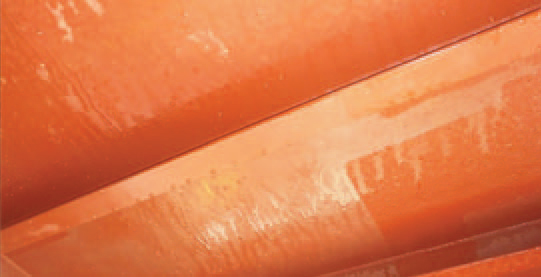
Ship’s sweat can be defined as the consequences from a change in temperature leading to condensation forming on the interior steelwork, which often drips down onto the cargo surface. The condensation forms upon contact of the warm humid air in the headspace with the relatively cooler steelwork, such as the hatch covers. This drips back onto the cargo and runs down the sides of the holds, creating a characteristic pattern of damage ‘drip lines’.
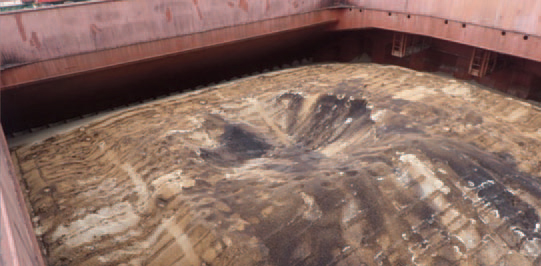
The increase in moisture content of the cargo directly wetted by water dripping creates an environment favourable for mould growth. Mould is alive and its metabolism releases heat into the environment as it grows, which in turn creates a favourable environment for self-heating of the cargo. The mould growth exacerbates the rate at which warm moist air is released into the headspace creating a condensation positive feedback loop.
Cargo sweat

Cargo sweat occurs under the same principle as ship’s sweat: a change in temperature leads to formation of condensation when warm and humid air encounters a colder surface. In this case however, the cooler surface is not the steelwork but the upper layer of the cargo itself.
This will occur if a cargo loaded in a cold climate is exposed to warmer air, either due to the hatch covers being opened or incorrect ventilation of the holds. The water vapour present in the introduced ambient air condenses on the cargo surface, which then leads to mould growth and localised heating in the same manner as ship’s sweat.
A proper ventilation regime helps by minimising the risk of ship’s sweat related damage and prevents the formation of cargo sweat.
How to ventilate
How can a Master ventilate to prevent these sweat issues?
First of all, the carrier and Master should identify whether there are any instructions in the charterparty or in the voyage order. If any instructions are unclear, the Master should clarify the instructions.
There are two rules that the crew can use to determine if ventilation is necessary. Both rules have advantages and disadvantages.
Dew Point Rule
Dew Point Rule is the most commonly seen rule when dealing with cargo claims. It requires that a cargo hold should be ventilated when the dew point of the outside ambient air is lower than the dew point of the air inside the headspace of the hold.
Air is said to be saturated if it can no longer absorb any moisture. If this air is cooled, it can no longer hold the same amount of moisture and the excess water vapour will condense on to a cooler surface – for example the relatively cooler steelwork. The temperature at which the water vapour in a given atmosphere condenses is known as the dew point temperature.
To apply the Dew Point Rule, the Master and the crew need to monitor the cargo temperature each watch for every hold and use these measurements to calculate the dew point. This method is only accurate when the measurements are taken properly.
Unfortunately there are several limitations that can render the measurements inaccurate:
- Measurements need to be taken in the hold headspace to obtain accurate dry and wet bulb temperatures; this implies that the crew need to have access to the headspace which is not always possible and is not recommended for safety reasons.
- The wet bulb temperatures need to be measured using a whirling hygrometer, which is rarely used. In practice, crews often obtain dry/wet bulb temperatures from the sounding pipes in the hold or from the access man holes which can lead to inaccurate and non-representative measurements.
- By entering the hold the crew can replace the air in the headspace if the measurement takes too long, which would render the measurements invalid.
In practice, the last hurdle with the Dew Point Rule is that it requires measurements and complex calculations to be performed every day. While a pre-made spreadsheet can be provided to the crew, errors still happen regularly and can add further uncertainty to the ventilation regime.
Three Degree Rule
This rule states that a cargo hold should be ventilated when the outside ambient dry bulb temperature is at least 3°C lower than the cargo temperature.
This method has several practical advantages and is usually recommended instead of the dew point rule as it is easier for the crew to implement.
- It simply requires comparison of the external ambient temperature to the cargo temperature rather than access to the headspace as required by the Dew Point Rule.
- It is safer, as the crew would be on deck for a reduced amount of time and no measurements from the holds need to be taken.
- There are no complex calculations required which limit the human error factor.
There is, however, the need for the crew, or an appointed surveyor, to monitor and obtain cargo temperatures for each cargo hold.
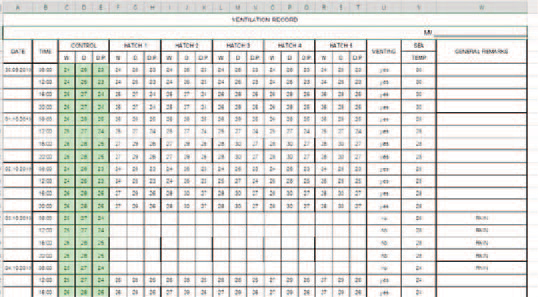
Ventilation record keeping
It is essential, no matter the ventilation rule, to keep a detailed record of the ventilation details as this will be crucial evidence in case of a claim at the discharge port. The charterparty or voyage orders may contain instructions as to what information and items should be recorded.
The ambient dry and wet bulb temperatures need to be clearly recorded every day at each watch, and the holds’ dry and wet bulb temperatures need to be recorded if the Dew Point Rule is used.
These ventilation logs should include a record of when ventilation was impossible due to prevailing sea or weather conditions. It is of the utmost importance that all relevant aspects of weather and sea conditions are fully recorded. It is also recommended that the heated fuel oil tank temperatures during voyage are recorded.
Ideally, the ventilation log should record the following information whether ventilation is performed or not:
- Outside air temperature (dry and wet temperature) and dew point.
- Hold air temperature (dry and wet temperature) and dew point.
- Sea temperature.
- Hold bilge soundings.
- Weather conditions (wind speed and direction, sea conditions, precipitation).
- Times when hold ventilation started and stopped.
- Times when ventilation window and/ or hatches are opened and closed.
- Cargo temperature measured during loading.
- Fuel temperatures in tanks associated with cargo holds.
Ventilation limitation
Proper ventilation is the only cargo care that a Master and crew can provide during voyage to limit condensation damage. Unfortunately, despite their best efforts, claims can still arise at discharge port from condensation related damage.
It is important to always keep in mind that proper ventilation cannot completely prevent the formation of condensation. Instead, it serves to minimise the formation of sweat. Since ventilation can only affect the headspace and the very upper layers of the cargo, when the inherent condition of the stow favours sweat formation, ventilation will treat the symptom but not the cause as it cannot dissipate heating deep within the stow. Self-heating cargo and hotspots deep in the stow can overwhelm the ventilation rate and release enough warm and humid air into the headspace to create condensation damage to the cargo surface despite the crew’s best efforts to ventilate.
Loss Prevention Essentials
- Pay attention to the voyage route and likely environmental conditions.
- Monitor and record the cargo temperature.
- Take careful note of the instructions contained in the charterparty or voyage orders.
- Evaluate which ventilation rule is to be used.
- Maintain a detailed ventilation and cargo monitoring record even if ventilation is not carried out.
Prepared in collaboration with CWA International