Introduction
Steel shipments typically involve substantial tonnages, with steel products often the sole cargo on the voyage. Steel shipments can involve many product types on the same voyage and may load from more than one port.
All steel will rust in the presence of water. Sea water wetting is particularly damaging with a rate of steel oxidation some 10 times higher than from fresh water alone.
There is no schedule for steel coils in the International Maritime Solid Bulk Cargoes (IMSBC) Code. Claims arising and therefore great care has to be taken to ensure that the condition of the loaded product is scrutinised and meticulously recorded and that all coils are stowed in an acceptable manner. It is vital that comprehensive records and high-quality photographs at each stage of the operations/journey, with date and time, are maintained.
Guidelines for the shipment of steel cargoes
1. Pre-loading
- Holds should be swept, washed down with fresh water and dried.
- A hold cleanliness survey should be carried out noting the vessel’s hold condition prior to loading, that no contaminants from previous cargoes are present and there is no moisture in any parts of the holds.
- Silver nitrate tests should be conducted to confirm absence of sea water residue.
- Hatches should be operational and watertight.
- Hatch covers should be dry before opening them.
- The stowage plan should be reviewed prior to loading.
- A pre-loading survey is always recommended. A detailed pre-loading report should be produced showing the extent of any exposure to rain/sea spray, together with photos highlighting cargo condition during transport of the steel to the wharf including rust observations and any steel distortion e.g. bent bars, bruised coils and damaged packaging.
- When cargo is already present at the wharf, key observations must include:
- All evidence of rusted steel, with silver nitrate tests to verify any exposure to sea water/spray.
- Any damage to product stacked at the wharf including bent bars, loss of strapping/unwinding on steel coils, extent of telescoping in the coil centre and loose outer laps on the coils, damage to coil edges.
- Comments on the effectiveness of any covering for protection of cargo at the wharf.
- Check coil banding integrity prior to loading. Coil shape is maintained by three evenly spaced steel bands around the perimeter of the coil (to avoid unwinding) and by four evenly spaced steel bands tied around the coil, passing through the eye of the coil. Without these bands the coils can partially unwind or telescope resulting in mechanical damage and subsequent claims, including handling costs and material loss due to rectification work.
2. During loading
- The coils’ surface quality, i.e. around the coil edges and in the centre of the coil, is easily damaged without careful lifting arrangements. Coils should be lifted with webbing rather than steel chains, as chains will almost certainly cause some damage to coil surface quality. When coils are handled by forklift truck, a round section single lifting tine, approximately 150mm to 200mm diameter, should ideally be used (see photo 1). Conventional rectangular forklift tines may cause distortion of the coil centre due to point loading. When round tines are not available, this presents a deficiency in the handling.
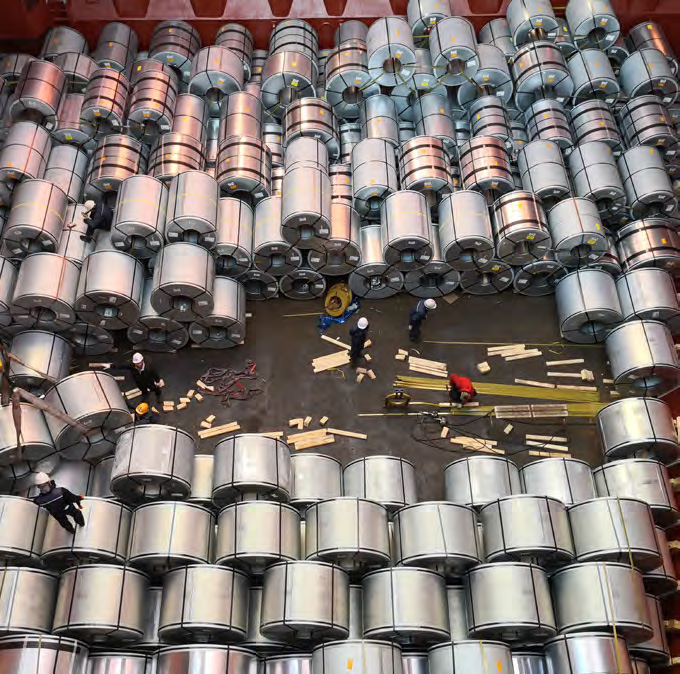
- Coils are stowed with the coil eye in a horizontal position. This is done for ease of handling and to minimise surface damage. Coil stowage depends crucially on the correct location of the lower layer of coils, with dunnage used as necessary to avoid damage to the tank top (or supporting structure) and the outer bulkhead. Comprehensive guidance on dunnage placement is given in the IMO’s Assembly Resolution A.714 (17), 1991 Code of Safe Practice for Cargo Stowage and Securing (CSS Code), as amended. The stowage of steel coils is quite complex, and guidance should be sought when in doubt.
- The dunnage utilised must be suitably dried to avoid transfer of moisture to the product and to the hold atmosphere. The dunnage must also be phytosanitary certified and approved to ensure the wood is pest free. Without this certification, the vessel may be banned from offloading cargo in some territories. Hardwood dunnage is preferred to avoid crushing during the voyage and consequential cargo damage.
- Steel coils must be anchored by wooden wedges (dry wood), which are nailed in position to the supporting dunnage board; the wedges are positioned to stop coils moving during rough seas. A centre coil, known as the locking coil, is positioned and secured by steel straps to the coils immediately below.
- When loading long products great care must be taken to place dunnage directly above the layer on the tank top and repeated for subsequent layers. High pressures can otherwise distort the steel cargo resulting in claims for bent plates/bars etc.
- Evidence of the appropriateness of the lifting equipment is very important as is the dunnage and dunnage spacing.
- If correct equipment is not present, this should be recorded as a deficiency in handling practice.
- Ensure Bills of Lading are claused, relating to defects/ abnormalities observed during the pre-loading and loading operations e.g. evidence of damaged straps, unwinding or telescoping, damage to packaging
3. During voyage
- Rust intensity can increase significantly in a 2-6 week voyage.
- The vessel should record throughout the voyage the temperature, relative humidity and dew point (both inside the hold and of the outside environment). The ventilation log should also indicate ventilation times.
- The need for ventilation depends largely on the temperature of the steel as loaded, the dewpoint of the air inside the hold, and the dewpoint of the air outside during the voyage.
- Appropriate ventilation of a vessel’s holds requires crew on board experienced in these procedures as incorrect actions can result in increased condensation during the voyage.
- A substantial proportion of steel shipments involve westerly voyages from China, with generally cold product loaded in several months of the year. These voyages mostly involve a south/south westerly journey, which soon passes through the tropics with high temperatures and high atmospheric humidity levels. The vast quantity of steel in these shipments will still be at a much lower temperature than the ambient air in the tropics, which will result in heavy condensation/water droplets on the steel product if hold atmospheres are not carefully controlled; in these circumstances ventilation should not be practiced. This does not solely apply to voyages originating in China.
- Efficient control of ventilation procedures requires appropriate humidity monitoring throughout the period on the vessel and throughout the voyage; if this is measured by a wet-bulb thermometer, the wet bulb must be spun at high speed, with a rotating sling device for sufficient time to reach equilibrium and the wet-bulb to reach an accurate value.
Conditions within the cargo hold must ensure that the dew point of the atmosphere in the hold is always above the temperature of the steel products in the hold. Wet and dry bulb temperature records should be carried out throughout the voyage.
Enclosed space entry procedures should always be observed when entering the hold. - Ventilation can proceed when the dew point of the air outside the hold is lower than the dew point inside the hold. A three-degree rule is adopted by some. When this approach is taken, ventilation should be practiced when the dew point outside the hold is at least 3°C below the temperature of the cargo taken during loading.
- It is very important to avoid sea water spray entering the hold during ventilation periods. If this is likely, ventilation should cease until conditions improve.
4.During discharge
- Great care needs to be taken when non-steel cargo is also carried on the same voyage. Contamination due to dust or contact with non-steel products stowed on top of the steel can cause damage to the steel especially when the non-steel cargo has a high moisture content.
- Oil drips onto the steel or dusting of the steel by the upper cargo can cause rejections; it is important that photographic evidence is kept of any cross contamination.
- Care must be taken to avoid sea spray entering the hold via the ventilation hatches or during periods when the hatch(es) are opened.
- Record as a deficiency in handling practice if correct equipment is not present.
- Handling guidelines noted in the loading section also apply to discharge, including dunnage quality and careful placement.
5. Risks associated with carriage
Hot Rolled Steel Coils (HRC)
HRCs are sometimes stored outside at the steelworks for short periods without any weather protection. A light rusting of the outer lap of the coil and coil edges will not normally result in a claim. If, however, water has been wind driven onto the sides of the coil, complaints are very likely. The water will be taken into the body of the coil by capillary action and will remain there for long periods as evaporation will be very slow, resulting in a rusted pattern across the coil surface as the coil is unwound. Exposure to sea spray is very likely to result in a substantial claim.
Cold Rolled Coils (CRC)
The coil width/weight is normally less than HRC. CRC is produced from HRC, normally after acid pickling and oiling and further rolling to produce a thin gauge strip.
CRC surface quality is critical for many applications. Any mechanical damage, oil spotting or water ingress into the steel within the double wrapped packaging will result in substantial claims. A thorough examination of the outer plastic wrapping (or steel wrapping) should be made, especially in the region of the eye of the coil for evidence of any water penetration into the surface protection. It is important to check for signs of rusting on the steel strapping which holds the coil in shape or for any signs of sweating or condensation inside the packaging.
A particular risk in CRC carriage is coil squashing if loaded below heavier and larger diameter HRC (see photo 2). This is a readily avoidable problem if CRC is stacked separate to the HRC or loaded in an acceptable pattern on top of the HRC.
Plate steel and cut-to-length strip
Many applications require a surface to be rust free or at worst with light rusting. Oil splashing on plate surfaces will normally raise complaints/claims. Most of this will arise at the producer mill, so identifying this problem pre-load can be very helpful in claims. These products are very susceptible to bending and must be handled with care at all stages. Care must also be taken to space the dunnage at regular intervals, with dunnage placement directly above each other in the stack to avoid plate bending.
Long products – beams/columns/sections/channels
Products in this group must retain the ‘as shipped’ condition as they are largely used in building construction. Careful slinging/ lifting and carefully placed dunnage is a priority – each piece of dunnage must be directly above the dunnage in the layer below and the dunnage spacing must not be excessive – normally not exceeding 2 – 3 metres. Spacing is dependent on the robustness of the product.
Long products – steel pipes/tubes/rolled sections
These products are often supplied with a surface coating. Careful handling of these products is essential to avoid claims; damage to the pipe external coating will result in a complaint.
Long products – reinforcing bars (rebar/debar)
Light rusting of bars is generally accepted; almost all bars will have some rusting on the bar ends as the surface is scale free and rusts easily. Some suppliers ship rebar/debar in coil form. Loss of rolling mill scale in the handling of this product can make the coils more susceptible to rusting. Many customers in the Middle East region have very strict standards and will frequently reject rusted bars, which will lead to substantial claims. Well documented pre-loading data showing rusting of bars can provide members with a high degree of protection from claims – if the rusting is not materially worsened during the voyage.
Steel slabs & bloom
The end customer will insist on a flat slab with no significant end-droop or longitudinal bend to allow smooth passage through the reheating furnace. These bars are quite sturdy – but could be ‘bowed’ if not lifted with a suitable spreader bar (see photo 3); if this happens the claims will be substantial.
Steel billets
It is vital that the billets retain their straightness in all directions. Billets can be damaged in the producer works when the continuous bar is cut to length; kinked ends can result with the end 50mm – 80mm noticeably bent due to the forces exerted in the cutting operation. This type of damage is almost impossible to create with slinging operations and claims based on this defect mostly lie with the producer steel mill. Billets are otherwise readily bent by rough handling anywhere from the producer mill to the consignee’s wharf (see photo 4).
The bars must be handled at all times with a long spreader bar, preferably equipped with fabric slings, to avoid material droop. Severe damage can be caused by forklift handling where the billets overhang the forklift tines by any appreciable distance.
Conclusion
Most voyages with steel cargoes will be uneventful, but sometimes things go wrong. The main causes of shipment claims are:
1. Rusting of steel: This is the largest cause of steel quality shipment claims, hence the need to have appropriate ventilation procedures to protect against condensation and to avoid sea water/sea spray contamination at all stages of the transportation of the cargo from the steelworks to the consignee.
2. Handling damage: Caused through inappropriate lifting procedures, inappropriate dunnage and/or dunnage positioning.
3. Stowage shift in rough seas: This will focus attention on the adequacy of cargo stowage precautions when claims are made.
Loss Prevention Essentials
- Hatches must be operational and watertight.
- Keep records of the cargo’s pre-loading condition and any handling damage occurring during loading/discharge.
- Cargo should be stowed according to a stowage plan preventing cargo from shifting during voyage and causing damage to the steel products.
- Appropriate ventilation procedures are vital to protect against condensation and to avoid sea water contamination.
Prepared in collaboration with CWA International
Downloads