Cargo Advice in Focus: Flighted Spongy Moth Complex
In collaboration with the cargo experts at CWA International, The Swedish Club has produced this practical advice to assist our members in the daily operation of their vessels.
The original advice was published in 2023, and this update was published in June 2026. The original advice can be downloaded at the bottom of this page.
Season 2026
Supplementary Loss Prevention Guidance
Applicability: All vessels trading to or via FSMC regulated areas with onward calls to Argentina, Australia, Canada, Chile, New Zealand, or the United States
1. Introduction
The 2026 Flighted Spongy Moth Complex (FSMC) season has commenced, and shipowners, operators, masters, and shipping lines are reminded to ensure full compliance with FSMC regulations applicable in destination states including Argentina, Australia, Canada, Chile, New Zealand, and the United States.
Regulatory authorities have indicated that FSMC populations may reach outbreak levels in 2026, like those observed in 2025. Consequently, inspection regimes, documentary verification, and enforcement measures are expected to be intensified throughout the 2026 season.
2. Overview of FSMC Risk
FSMC is a highly destructive invasive pest native to parts of Asia, including China, the Russian Far East, Japan, and Korea. Female moths are capable of flight and are attracted to artificial lighting, particularly on vessels alongside or at anchorage.
Egg masses may be deposited on:
- Ship hulls and superstructures
- Accommodation blocks
- Cargo, containers, vehicles, and equipment
- Sheltered or recessed structural areas
FSMC egg masses are resilient and can survive extreme weather conditions and long-distance transit and pose a significant biosecurity threat if introduced into non‑native environments.
3. High Risk Vessel Definition
A vessel will generally be considered high risk if it has:
- Called at a FSMC regulated port or area
- During the specified risk period
- In the current or previous year, or up to 24 months, depending on the destination country
High risk vessels are typically required to:
- Obtain an FSMC free inspection and certificate at the last port of call in a regulated area
- Submit port of call history and documentation prior to arrival
- Remain subject to arrival inspections, even when holding a valid certificate
4. Lack of Harmonisation Between Countries
FSMC regulations are not fully harmonised between regulating countries. Differences exist in:
- Regulated areas
- Specified risk periods
- Look‑back periods
- Documentation timelines
- Inspection and enforcement practices
Operators are therefore advised to verify country specific requirements prior to each arrival and not assume that compliance in one jurisdiction will satisfy the requirements of another.
5. Key 2026 Regulatory Developments
United States & Canada
- Increased enforcement intensity during the 2026 season
- Closer scrutiny of self‑inspection records
- Higher likelihood of arrival inspections, including for certified vessels
- Mandatory submission of 24‑month port of call data at least 96 hours prior to arrival
Noncertified vessels may be inspected at every port, and detection of FSMC may result in removal orders, reinspection at subsequent ports, or port exclusion.
Australia
- Heightened FSMC surveillance period advanced to:
- 1 January to 31 May 2026
- Expanded automated pre‑arrival targeting and digital screening via MARS
- Increased focus on vessels that have called at Eastern Russian ports:
- Between 40°N and 60°N, west of 147°E
- During 1 July to 30 September
- Within the previous two calendar years
Vessels identified as high risk may be required to undergo inspection or additional biosecurity mitigation measures upon arrival.
New Zealand
- FSMC look‑back period limited to 12 months
- Certificates must:
- Be issued at the last regulated port
- Be conducted during daylight hours
- Be issued on the same date as departure
- Vessels arriving without compliant documentation may be directed to inspection:
- At a designated port, or
- Offshore (up to 4 nautical miles) where risk is assessed as high
Chile and Argentina
- Both jurisdictions apply a 24-month look‑back period
- Strict pre‑arrival documentation submission deadlines
- Argentina applies broader regulated area definitions than NAPPO, including all ports in China and modified Japanese prefecture classifications
6. FSMC Self‑Inspection Requirements
Vessels and shipping lines are required to conduct self‑inspections prior to entering ports in FSMC regulated countries.
FSMC egg masses are frequently found in sheltered, shaded, or poorly ventilated areas, particularly where moths are attracted to artificial lighting. Special care should be taken when inspecting, but not limited to, the following locations:
- Around the accommodation block (house/superstructure)
- Lighting fixtures, floodlights, and light housings
- Hatch coamings, recesses, and adjacent structures
- Areas where airflow is limited or stagnant
These areas must be inspected methodically and with due care. Inspection results, including confirmation of a clean inspection, should be properly recorded in the ship’s logbook, and photographic evidence is strongly recommended where practicable.
Failure to conduct and adequately document self‑inspections may result in arrival delays, additional inspections, removal orders, or other enforcement action by port authorities.
7. Operational and Claims Implications
FSMC related losses commonly arise from:
- Invalid, expired, or incorrectly issued certificates
- Incomplete or inaccurate port‑of‑call histories
- Failure to conduct or document self‑inspection
- Misinterpretation of differing national requirements
FSMC incidents are generally considered foreseeable and procedural in nature. It is important that appropriate due diligence is undertaken and documented.
8. Recommended Loss Prevention Measures
Shipowners, operators, and masters are advised to:
- Maintain a rolling 24‑month port history for each vessel
- Identify FSMC exposure early during voyage planning
- Ensure inspections are conducted:
- At the correct port
- Within validity periods
- In accordance with daylight and timing requirements
- Implement structured onboard FSMC awareness and inspection routines
- Engage port agents early and independently verify local requirements
- Review charterparty risk allocation, including the BIMCO FSMC Clause for Time Charter Parties
9. Conclusion
FSMC remains a predictable and high impact biosecurity risk for international shipping. Given the extended look‑back periods of up to 24 months, continuous vigilance, crew awareness, and procedural discipline are essential.
A robust compliance and self‑inspection regime, supported by accurate documentation, is critical to mitigating the risk of delays, operational disruption, and associated claims during the 2026 FSMC season.
For further guidance, members are encouraged to contact the Loss Prevention Department.
This month, we wish to highlight the flighted spongy moth complex. Outside their native range, FSMC can cause significant destruction to trees with subsequent negative effects on the wider forest ecosystem and any associated industries such as tourism, timber, and paper manufacturing. One of the major sources of FSMC transmission/movement around the world is via the maritime shipping route with FSMC egg masses being laid on ships, containers or cargo.
Read the original article
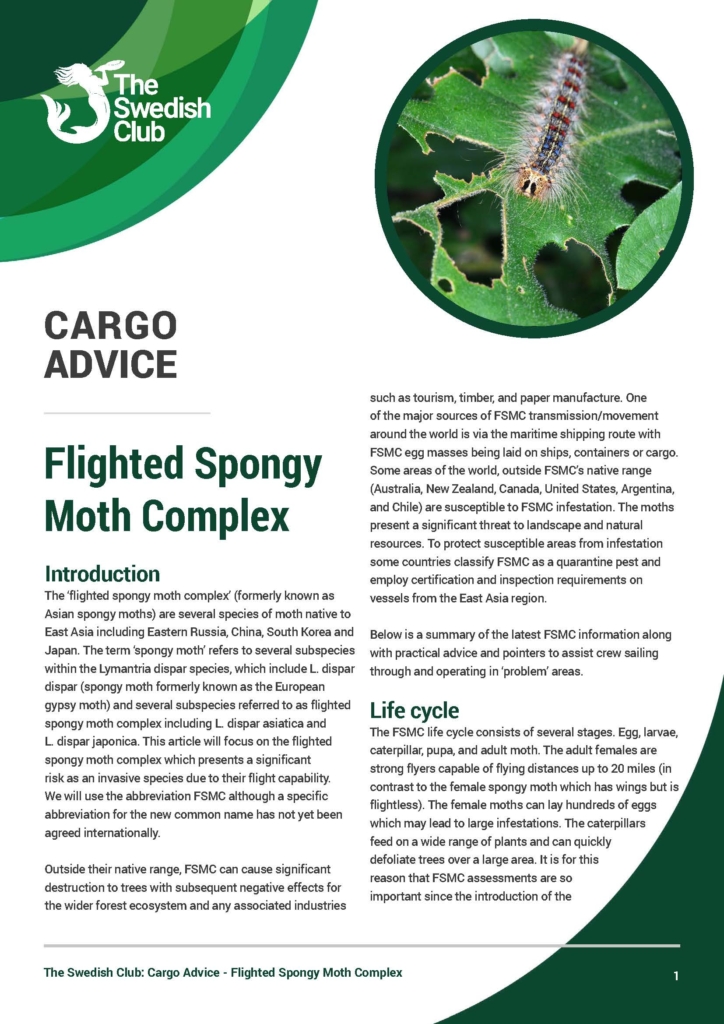
Flighted Spongy Moth Complex (formerly known as Asian Spongy Moth)
Flighted Spongy Moth Complex (formerly known as Asian Spongy Moth)
Outside their native range, FSMC can cause significant destruction to trees with subsequent negative effects on the wider forest ecosystem and any associated industries such as tourism, timber, and paper manufacturing. One of the major sources of FSMC transmission/movement around the world is via the maritime shipping route with FSMC egg masses being laid on ships, containers or cargo.Chinese translation